The fastest channel to pay you back is usually the one that pays you least.
Switching from CPA to payback was the right move. But payback hides a second trap: optimise for how fast the cash comes back, and you defund the channels that climb highest. We call that the Speed Trap. The way out is Curve Height — where the curve ends up, not how fast it crosses zero.

Switching from CPA to payback was the right move. But payback hides a second trap of its own: optimise for how fast the cash comes back, and you systematically defund the channels that come back slowest and climb highest. We call that the Speed Trap. The way out is to judge a channel by Curve Height — where its contribution curve ends up, not how fast it crosses zero.
TL;DR — Adopting payback period over CPA fixes one problem and quietly introduces another. Payback measures when a cohort returns its cost, not how much it returns after — and those two diverge sharply. Fast-paying-back channels tend to be transactional and shallow; slow-paying-back channels tend to compound for months or years. Enforce a strict payback-speed target and you mechanically starve your highest-value channels while concentrating spend into your most disposable players — the Speed Trap, which is the CPA Ratchet wearing a new metric. The fix is to manage on Curve Height: the eventual height of a channel's cumulative contribution curve, not the date it breaks even.
In The CPA Ratchet we argued the way out of cost-per-acquisition was to manage channels on what a cohort actually returns — Channel Yield — rather than what each conversion costs at sign-up. That argument stands. This one picks up immediately after it, because the moment you adopt payback as your lens, a new failure mode moves in behind the old one.
It's the same shape as the one CPA Ratchet described. Any number you optimise becomes a steering wheel, and payback steers too. The only question is where.
(Figures here are directional ranges drawn from modelled industry benchmarks, not precise values.)
1. The new metric is also a steering wheel
The relief of switching to payback is the feeling of having fixed the measurement problem — cost per acquisition rewarded cheap conversions, payback rewards real return, so the incentive is now honest.
It's more honest, and it's still an incentive. The moment payback becomes the target a team optimises toward, it starts selecting — the same way CPA did. And what payback selects for is not value. It's velocity: the speed at which money comes back to the balance sheet. A metric that ranks channels by how fast they repay will quietly reshape your mix toward whatever repays fastest, whether or not that's whatever's worth most. You haven't removed the steering wheel. You've turned it to a new heading and taken your hands off again.
Payback fixed what CPA measured. It didn't fix the habit of optimising a single number until it bites.
2. Speed is not size
The intuition is straightforward and almost always unexamined: a channel that pays back in three months is better than one that takes nine. Faster is healthier. Less risk, sooner.
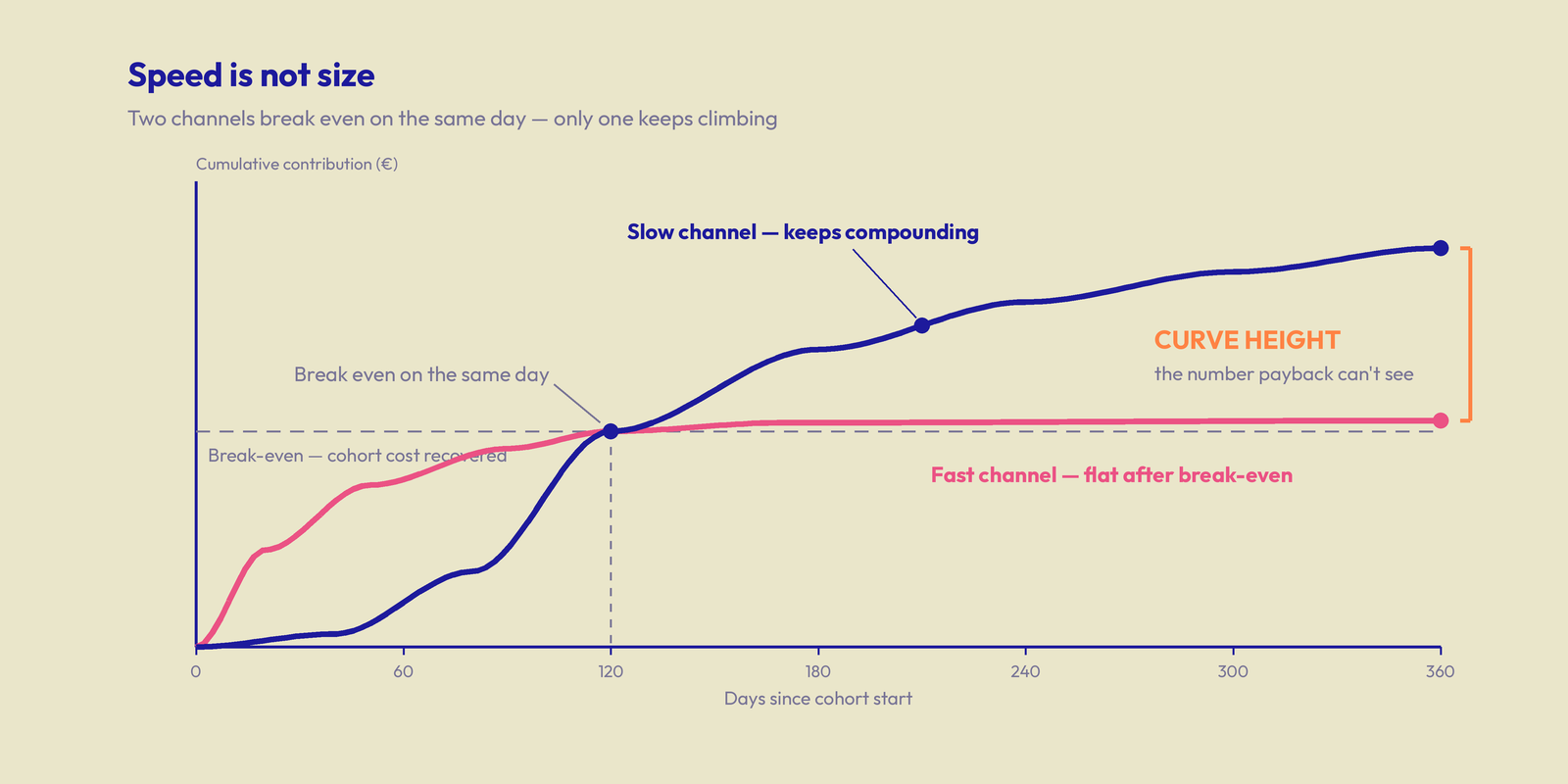
Faster is not the same as bigger, and conflating them is the whole error. Payback marks the date a cohort's cumulative contribution crosses its cost — and says nothing about what the curve does afterward. Lower-funnel, transactional channels deliver most of their lifetime value in the first week or two and then go flat; they break even fast and stop. Brand, organic, and high-affinity affiliate channels ramp slowly — a fraction of their value in the first month — but keep compounding for months or years, because the players they bring carry lower churn and keep redepositing long after the cost was retired. Two channels can break even on the very same day, and one keeps climbing while the other has already given you everything it ever will.
That eventual altitude — where the cumulative curve actually ends up — is Curve Height, and it's the number payback can't see. Break-even is a date. Height is the business.
3. The Speed Trap
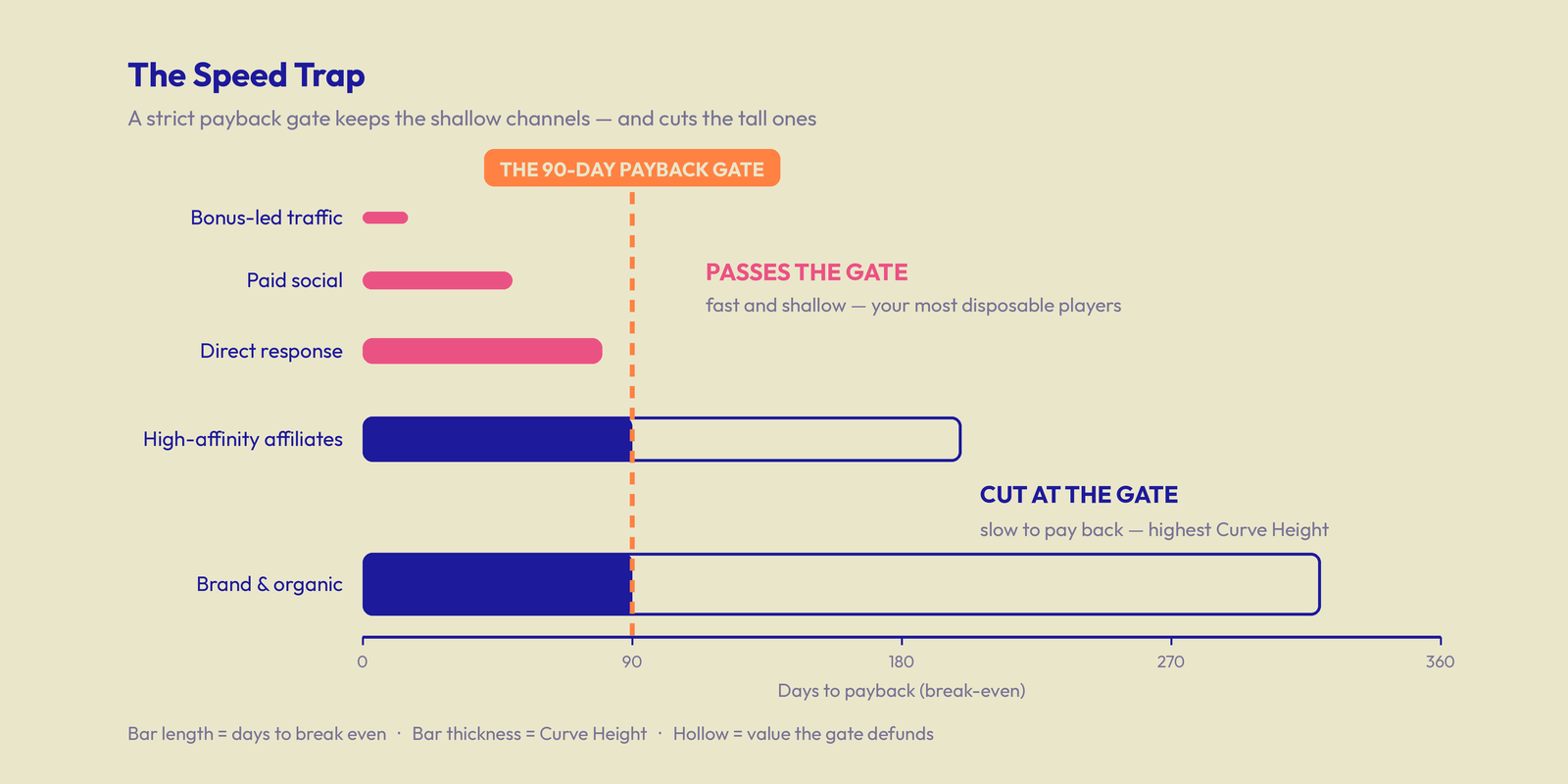
So you set a disciplined rule — payback inside ninety days, say — and enforce it across the portfolio. It feels like rigour.
It's a filter that removes your best assets. A strict short-horizon payback target mechanically defunds every slow-compounding channel, because slow-compounding channels fail the test by design — they were always going to cross break-even late and climb high. Cut them, and two things follow. You lose the high-Curve-Height players you'll most miss in a year. And you make yourself dependent on lower-funnel direct response, which means bidding harder against everyone else doing the same, which drives your own acquisition cost up across the board. There's a second blade, too: in this industry the fastest paybacks are often the worst cohorts — bonus-led traffic that front-loads deposits, repays in days, and then churns the moment the welcome offer clears. Speed isn't just failing to find value. It's frequently a marker of its absence.
This is the Speed Trap, and it is the CPA Ratchet one level up: optimise the convenient number, select the disposable player, tighten every cycle. You changed the metric and kept the mistake.
4. The right payback window isn't yours to choose
The tidy instinct is to set one payback target — a single number the whole business is held to, clean enough to put in a board deck.
A flat target across a mixed portfolio is a capital-allocation error, because the correct window isn't a preference. It's set by geography and product. In the most competitive regulated markets, the largest companies run payback windows of well over a year — sometimes multiple years — entirely on purpose, because the players there are worth several times their counterparts elsewhere and compound for far longer; a long horizon there is correct, and financing it with external or parent-company capital is a deliberate growth choice, not a failure of discipline. In lower-value, high-volatility markets, the opposite holds: a short, sub-quarter payback filter is the right risk control. And product shapes the curve before geography does — casino cohorts monetise fast and decay fast, sportsbook cohorts ramp gradually against the fixture calendar. Hold all of that to one number and you starve the premium markets of scale while overfunding the volatile ones. The aggressive-growth heading and the fast-payback heading genuinely pull in opposite directions; pretending one target serves both just hides which one you sacrificed.
A payback window you picked in a meeting is a guess. The market already set the right one.
5. The blended average is hiding the same thing it always did
Having adopted payback, the natural move is to watch the portfolio figure — a healthy blended payback of, say, a little over a year, and call the engine sound.
That blended number is the blended-CAC illusion in a new costume. A respectable portfolio average routinely conceals channels at the extremes: near-zero-cost organic repaying quickly, sitting alongside non-segmented paid search that doesn't repay for two years and may never. Averaged together they look fine; separately, one is underfunded and the other is destroying capital. CPA Ratchet made this point about cost; it's no less true of payback, and the fix is identical — report at cohort level, cut by channel, geography, product, and registration vintage, never in aggregate. A meaningful share of paid cohorts in this industry never reach payback at all, their unrecovered cost quietly absorbed by a small pool of high-value players. A blended figure is precisely the instrument that lets that keep happening.
An average payback is a number that feels like an answer and works like a blindfold.
6. You're allocating on a curve that hasn't finished
All of this assumes you can see the curves you're judging. You can't — not in time. Payback is a trailing metric; a real curve takes months or years to mature, and the budget decision is weekly. Wait for the curve to complete and you'll either scale a loser for two extra quarters or miss the window entirely.
Which means Curve Height, the number that matters most, is also the one that arrives last — unless you project it. Early behavioural reads in a cohort's first days — how fast players return, how retention is settling, how cadence is forming — map closely onto where the curve eventually lands, closely enough to estimate Curve Height while the allocation decision is still open. This is what D1LTV — Day-1 Lifetime Value Prediction, one of HumanGraph's three core engines, is built to do: score predicted value per channel and cohort from the first deposit and first sessions, so you can rank channels on projected height rather than waiting on observed speed. Payback runs on velocity because velocity is the only thing visible early. Give the decision a height estimate in the same window, and you can stop rewarding the wrong one.
The channel that pays you back slowest may be the one building your business. Manage to the speed and you'll cut it before it ever gets the chance to prove it — which is the whole point of measuring height instead.
Where bonus-led acquisition fits into all this — and why it flatters its own payback — is the territory of The Generosity Trap. We built HumanGraph to operate against exactly this kind of problem. If the Speed Trap is something you'd like to climb out of at your operation, we'd like to compare notes.