Cash rents players. It doesn't keep them.
Cash bonuses buy activity and zero ownership. A player who deposits for a match has been rented, not retained. We call it Rented Loyalty — and the operators pulling ahead have stopped paying for it.

TL;DR — Cash bonuses are very good at producing activity and very bad at producing attachment. A player who deposits for a 100% match has been rented, not retained: the moment the offer expires, so does the relationship. We call this Rented Loyalty. Experience-led mechanics — progression, status, earned rewards — work because of The Ownership Premium: players value what they had to earn far above the cash it is made of, and that value can't be poached with a competitor's welcome offer. Build engagement players own, and you stop renting the same churn back to yourself, week after week.
In The Generosity Trap, we made the case that most bonus spend is margin cost in disguise — and that most of it lands where it changes nothing. That article closed on an unfinished question: if cash is the wrong default, what is the right one? This is the article that answers it.
Because the way most gaming companies spend their engagement budget gives the game away.
1. Cash buys activity. It never buys ownership
When a player deposits because of an offer, the instinct is to count it as a win. Acquisition worked. The player is on the platform. The relationship has begun.
That instinct is reading the wrong thing. What you have bought is activity, not attachment — and the two behave completely differently the moment the offer stops. A player who showed up for a 100% match shows up for the match. When it expires, or a competitor posts a marginally better one, there is nothing holding them, because there was never a relationship. There was a transaction wearing the costume of one.
This is Rented Loyalty: engagement you are paying rent on, due again every cycle, owned outright never. It is why more than half of newly acquired players are gone inside their first year, and why so much of that churn isn't a product failure at all. It is the predictable result of acquiring people with cash and then being surprised that cash is the only thing keeping them.
A rented player isn't loyal. They're just between offers.
2. The numbers say experience outlasts cash
The case for moving spend away from pure cash isn't a matter of taste. It shows up in how cohorts behave over time.
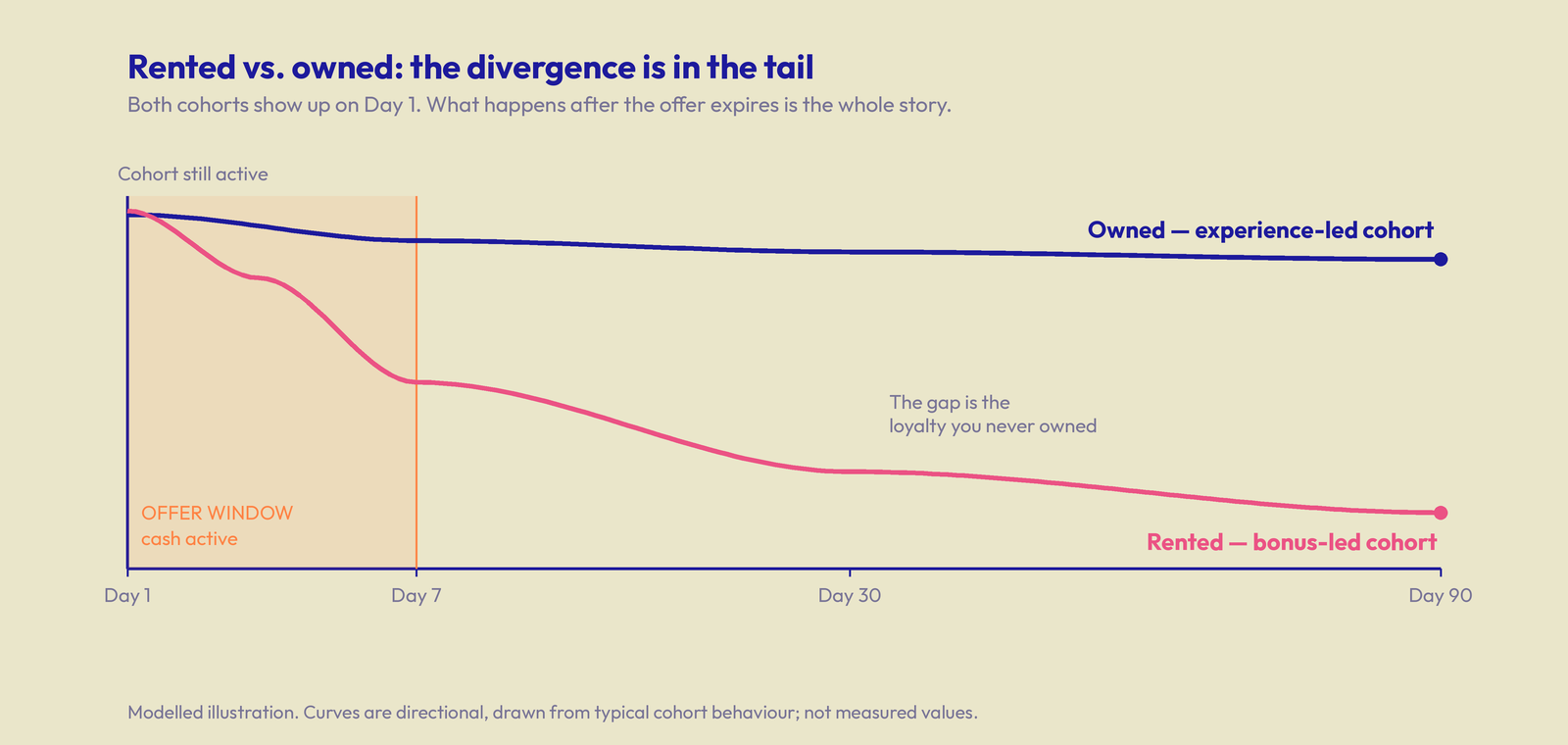
On Day 1 there's barely a gap — almost everyone shows up at the start, whatever brought them. The divergence appears later, and it widens the further out you look. By the end of the first week, gamified cohorts tend to run something like half again as active as bonus-led ones. By Day 30, the difference is often close to double. Lifetime value follows the same curve, with mature progression programmes reporting anywhere from a third more to several times the flat, incentive-only baseline. The pattern is consistent: cash gets players through the door, and experience decides whether they stay.
(The figures here are directional ranges, not precise measurements — the shape of the pattern is the point, not the decimal.)
There's an honest confound to name. Players who engage with progression may simply be more engaged to begin with. Some of the effect is selection. But the controlled comparisons — same reward, delivered two different ways to comparable players — strip the confound out, and they point the same direction. More on those next.
One operational detail decides whether any of it works: timing. A milestone acknowledged mid-session, while the player is still in the seat, reinforces the behaviour. The same acknowledgment sent the next morning by email — after a nightly batch sync — does not, because the moment it was meant to reward is gone. A great deal of what passes for gamification is really retrospective CRM with a progress bar bolted on, and it underperforms for exactly this reason. The loop closes in real time or it doesn't close.
Cash gets them through the door. Experience decides whether they unpack.
3. Earned rewards beat the cash they're made of
The strongest evidence isn't the retention curve. It's the experiments that hold the reward constant and change only how a player gets it.
In one controlled test, players were offered an identical cashback reward two ways: dropped straight into the account, or unlocked by playing through a short interactive sequence to claim it. Same money. The version players had to work for was redeemed something like half again as often as the version handed over for free. The reward didn't change. The player's relationship to it did.
That is The Ownership Premium — the extra value people place on anything they had a hand in earning. A reward that costs nothing to receive is valued at roughly what it cost: nothing, emotionally. A reward that took effort acquires a worth the cash amount alone can't explain, because the player now has something invested in it. Direct cashback is the weakest possible reward precisely because it asks for nothing.
Underneath sits a simple truth about motivation. People sustain a behaviour when three needs are being met: a sense of control over their choices, a sense of growing competence, and a sense of connection to others. Cash satisfies none of them — it's fungible, instantly comparable across competitors, and emotionally inert. Progression mechanics, designed well, hit all three: players choose their own path and how to spend what they earn, they see visible proof of mastery, and they locate themselves among other players. That's the line between motivation that evaporates when the reward stops and motivation that no longer needs the reward at all.
Two design details do most of the work. The first is the goal-gradient effect: effort accelerates as a goal gets closer. A player staring at an empty bar is fragile and easily lost; a player shown a bar already part-filled — a head start they didn't earn — pushes harder toward the finish than the maths justifies. The second is anticipation. The brain's reward response is driven less by the reward than by the uncertainty leading up to it, which is why a predictable, identical payout fatigues fast and a variable one keeps attention. It is also the most ethically loaded tool in the kit — a point we come back to.
Hand a player cash and you've given them money. Make them earn it and you've given them a reason to come back.
4. Heavy bonusing trains the dependency it's meant to cure
There's a sharper version of the cash problem, and it's the one that should worry commercial teams most. Heavy financial incentives don't just fail to build loyalty. They can dismantle the loyalty that was already forming.
The mechanism is the overjustification effect. Pay people to do something they were already doing for its own sake, and you quietly change their understanding of why they're doing it. A player who started out thinking I play because this is fun gets re-trained, by a steady drip of offers, into thinking I play to collect the bonus. Once that switch flips, the intrinsic reason is gone — and it doesn't come back when the offers stop. It's the same dynamic that turns a hobby into a chore the moment someone starts paying for it.
This is the engine behind the dependent player The Generosity Trap described — the one whose short-term metrics look healthy and whose long-term economics are poor. Some of those players aren't a fixed type who arrived that way. They were manufactured, by teaching otherwise-organic users that the reason to log in is the offer in the inbox. And once a base has been conditioned to wait for the next promotion, you're locked into a bidding war you can't win, because every competitor can match a number.
Cash is the one reward with no moat around it. Anyone can match it, so eventually everyone does.
5. The mechanics that build — and the line that defines them
Not all gamification earns its keep. The industry is littered with progress bars that decorate without doing anything. A handful of mechanics consistently do the real work — and each one has a version that builds and a version that exploits.
Missions and quests give players a reason to act that isn't “deposit more,” but only when they're relevant: a generic checklist served to everyone is noise, while challenges matched to how a player actually behaves establish a rhythm of return. Tiered progression works when it's visible during play rather than buried in a menu, so a losing session still contributes to something permanent. Soft currency — a branded token earned through play and spent in an on-site store — is the most underused mechanic of all, because it decouples the reward loop from cash entirely and hands the player a choice about how to spend what they earned. That choice is The Ownership Premium, manufactured on purpose.
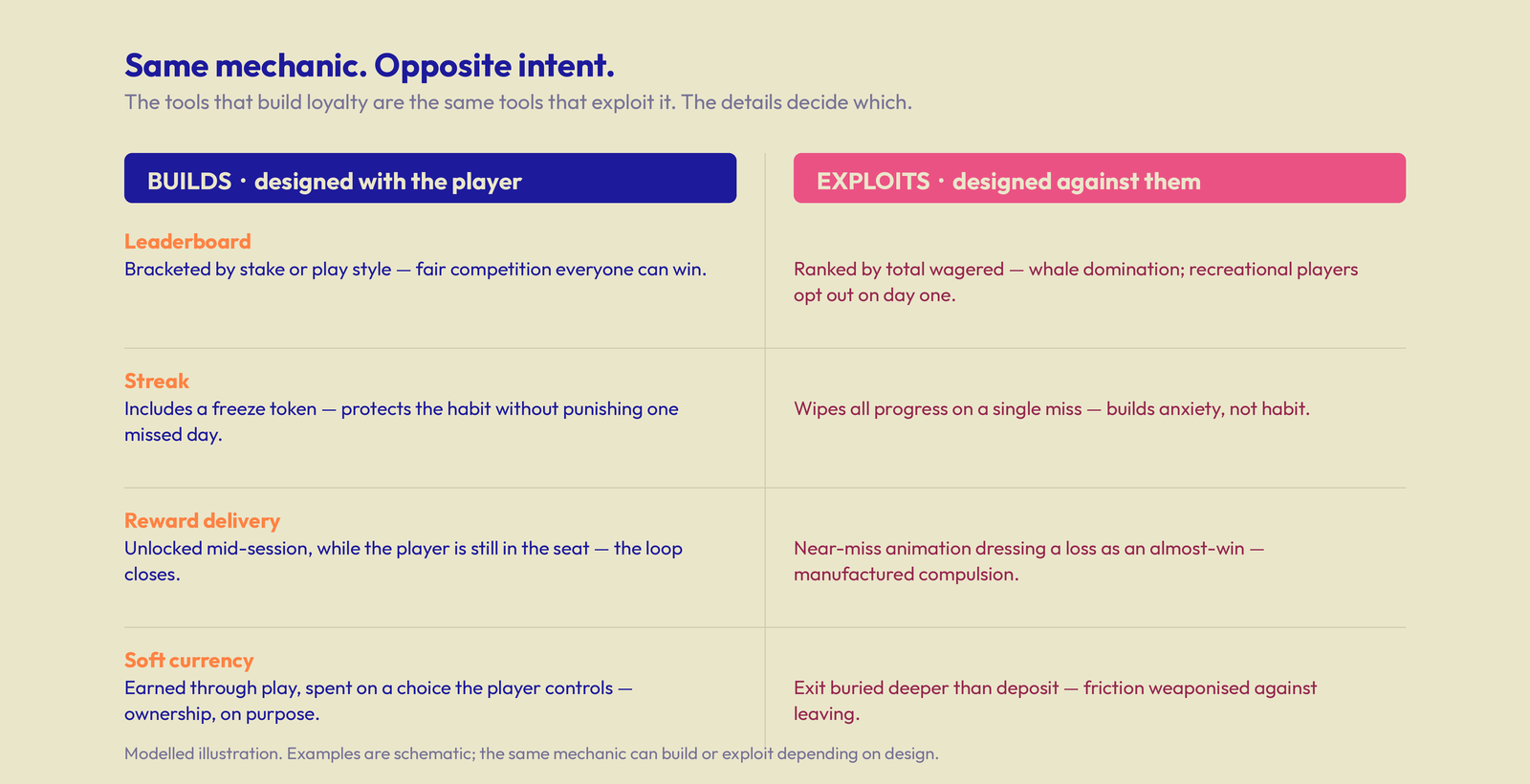
Then there are the mechanics where the line is thin. A leaderboard ranked by total wagered produces whale domination — a handful of high spenders own the top, every recreational player learns within a day the game isn't for them — while the same leaderboard bracketed by stake or play style becomes fair competition. A streak that wipes all progress on a single missed day doesn't build habit, it builds anxiety; the same streak with a freeze token built in protects the loop without weaponising it. The mechanic is identical. The intent, written into the details, is the whole difference.
And that difference is now the regulatory frontier. As duty regimes tighten across regulated markets, margin-burning cash campaigns are becoming simply unviable, which is half the reason experience-led engagement has stopped being optional. The other half is that the exact tools that build engagement, turned slightly, become the manipulation regulators are now hunting: the near-miss animation that dresses a loss as an almost-win, the login streak engineered around fear of loss rather than enjoyment, the leaderboard that turns spend into social pressure, the exit button buried deeper than the deposit button. These aren't separate from gamification. They are gamification, designed against the player instead of with them.
The players worth designing for most carefully are the ones whose early behaviour already marks them as future high value — re-depositing fast, escalating stakes, exploring the product. Those patterns show up inside the first week, and reading them early is the job of EVIP — Early VIP Identification, one of HumanGraph's three core engines. Spotted in time, a high-potential player can be routed out of the generic journey before a flat welcome sequence trains them to expect ordinary.
The mechanic is identical. The intent is the whole difference — and increasingly, it's the difference the regulator reads too.
6. Stop renting players. Build something they own
None of this is an argument for abolishing cash. Players come to gamble for real money, and a platform that buried every reward behind a mini-game would be insulting the reason people are there. The goal isn't to remove cash. It's to change where it sits.
In a well-built economy, the same deposit match that would have been emailed to a cold list arrives instead as the unlock at the top of a tier the player climbed. Same money — but it now carries the weight of everything that preceded it, and it reinforces the progression system instead of competing with it. Cash stops being the bribe to enter and becomes the payoff at the end of an earned journey.
The catch is that this is harder than writing offers, because it asks you to know two things cash never required. Which players are worth the design effort — and when a player's engagement is starting to change, while there's still time for a quest or a milestone to matter rather than a desperate win-back after they've gone. Detecting that drift early is the job of COD — Churn Onset Detection, another of the three engines; knowing a player's likely value from the first sessions is D1LTV — Day-1 Lifetime Value Prediction. Cash bonusing is crude partly because it's easy — it asks nothing of the operation except budget. Building loyalty asks for an understanding of players that arrives early enough to act on.
That's the harder road. It's also the only one that ends somewhere other than a bidding war. A tier earned, a streak held, a status that means something only here and nowhere else — none of it ports to a competitor, and that non-portability is the entire point. It's the difference between a player who can be poached with a welcome offer and one for whom leaving means starting over.
You can pay players to show up. You can't pay them to care.
We built HumanGraph to operate against exactly this problem. If moving spend from rented loyalty to engagement players actually own is something you'd like to act on at your operation, we'd like to compare notes.