Bonuses are expensive. Most of them shouldn’t be sent.
Bonuses feel like marketing spend. In reality they are direct margin cost — and most of that cost lands on players where it does nothing. This is the Generosity Trap.

TL;DR — In iGaming, bonuses are treated as the default answer to almost every commercial problem. The problem is not that bonuses don’t work. It is that most bonus spend lands on players where it does nothing — engaged players who would have returned regardless, promotional extractors who never come back, and at-risk players caught at the wrong moment. We call this the Generosity Trap — the structural shape of bonus economics when operators give broadly because they don’t have the intelligence to give selectively. This article explains the four groups bonuses actually go to, the math of the trap, and what changes when targeting is sharpened.
1. Bonuses are a margin cost, not a marketing one
In the first four articles in this series (The Invisible Window, The Descending Curve, The Competitor Exposure Window, and The Value Visibility Gap), we argued that the cost of acting late, or acting indiscriminately, on player behaviour is structurally underestimated. The same is true of bonuses.
In iGaming, bonuses are treated as the default answer to almost every commercial problem. Player not converting? Send a welcome offer. Player going quiet? Send a retention bonus. Player not returning after a week? Send a reactivation incentive. VIP not logging in? Escalate the offer.
The instinct is understandable. Bonuses work — when they are used correctly. The problem is that most bonus spend is not used correctly. It is distributed too broadly, too early, too late, or to the wrong players entirely.
The deeper issue is how bonuses are categorised in operator commercial models. Bonuses feel like marketing spend. They are budgeted alongside it, optimised against it, and reported alongside it. But economically, a bonus is not a marketing cost. It is a direct margin cost — money taken off the gross gaming revenue line and given back to a player on the assumption that they will repay it with future activity.
When that assumption is wrong, the cost is permanent. The margin doesn’t come back.
A bonus is not a marketing dollar. It is a margin dollar in disguise.
2. The four groups bonuses go to
The foundational error in bonus strategy is treating the player base as homogeneous. In practice, players fall into four meaningfully different groups when it comes to promotional sensitivity — and the appropriate action for each is very different.
Group 1: Engaged anyway. These players would have deposited and returned regardless of the bonus. Sending them an offer does not change their behaviour. It simply reduces the margin on a relationship that was already healthy. For this group, bonuses are pure waste.
Group 2: Only here for the bonus. These players are primarily motivated by offers. They engage when incentivised and disengage when the value runs out. Their short-term metrics can look strong — first deposit completed, wagering requirement met — while their long-term economics are deeply negative. For this group, bonuses subsidise a relationship that was never real.
Group 3: Genuinely shiftable. These are the players where bonus spend creates real return. Their behaviour can be changed by the right offer at the right moment. They engage more deeply when given an appropriate incentive, and they continue engaging after the incentive has been consumed. This is the group bonuses are designed for — and it is the smallest of the four.
Group 4: At-risk, behaviourally shifting. These players are genuinely beginning to disengage, but the timing and nature of the intervention determine whether the bonus works. The same offer sent too early, before the player’s pattern has meaningfully changed, may do nothing. The same offer sent at the right moment may change the outcome.
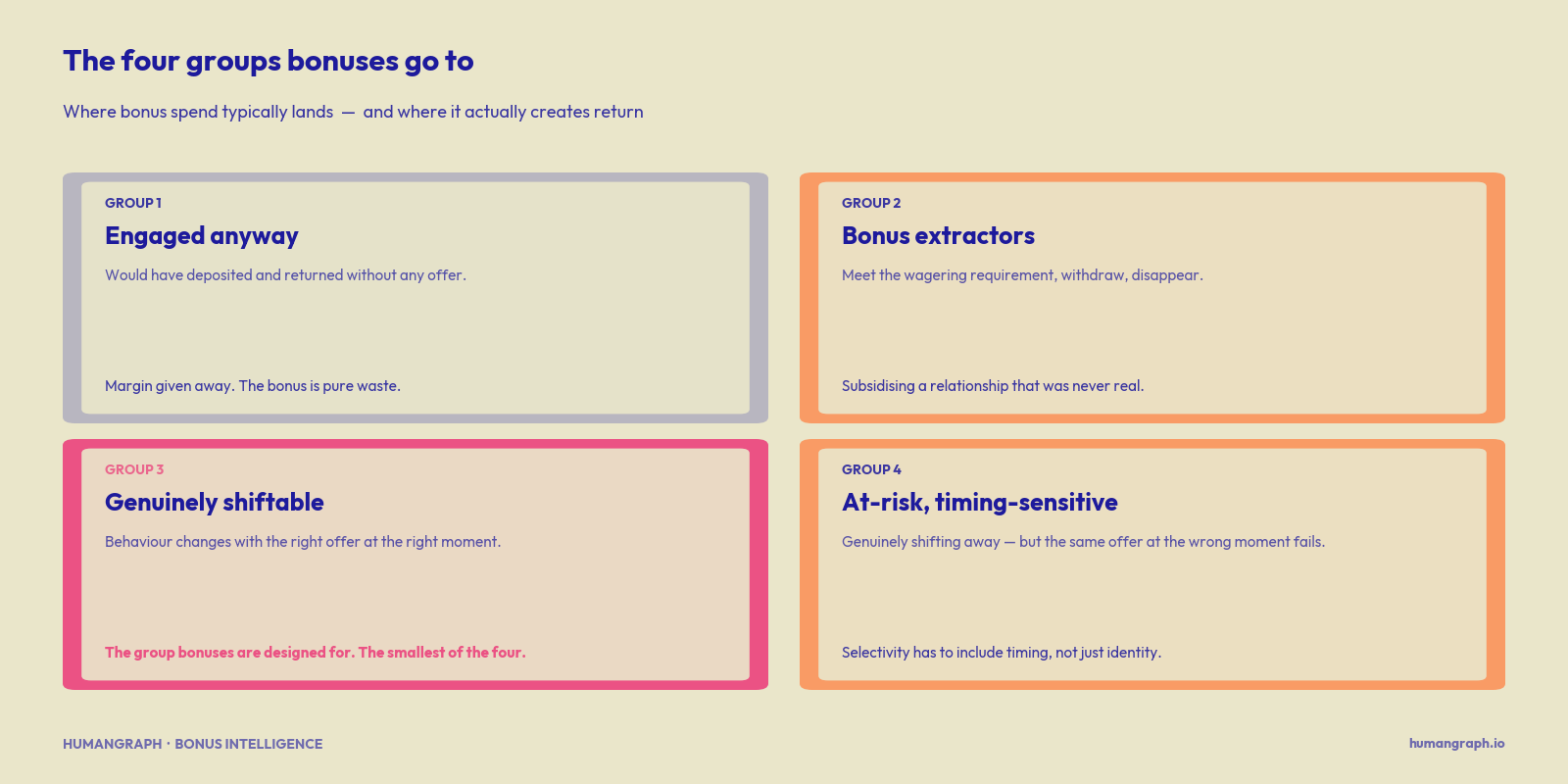
The volume of bonus spend isn’t the problem. The distribution is.
3. The Generosity Trap
We introduced the concept of Generosity Scaling in The Invisible Window — the discipline of matching bonus intensity to player potential rather than spreading it broadly. The opposite of Generosity Scaling is what we call the Generosity Trap — the structural shape of bonus economics when operators give broadly because they don’t have the intelligence to give selectively.
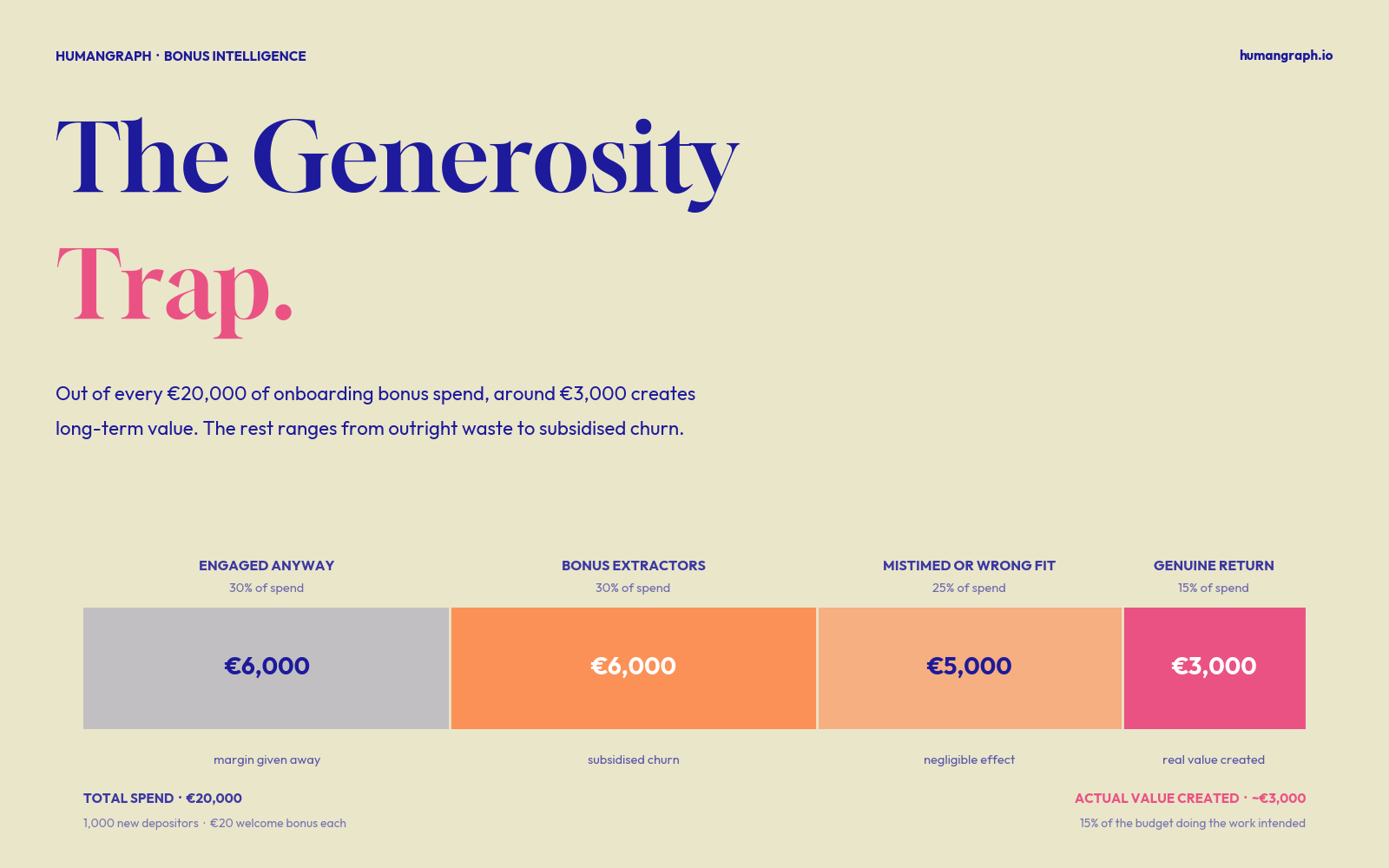
The math of the trap is unforgiving. Picture a typical operator’s onboarding flow. One thousand new depositors arrive in a month. Each receives a €20 welcome bonus.
Total spend: €20,000.
Of that thousand, a meaningful share are players who would have engaged anyway — drawn in by brand, product, or peer recommendation. Industry data and operator experience suggest this group is typically around 30% of new depositors. Their €6,000 in bonus value is margin given away on a relationship that needed no incentive.
Around another 30% are promotional extractors. They will meet the wagering requirement, withdraw what they can, and disappear. Their €6,000 in bonus value is the cost of attracting and serving a relationship that was never going to exist.
A further ~25% are players where the offer fits weakly — the timing is wrong, the product fit is wrong, or the player’s underlying engagement pattern doesn’t match what the bonus is designed to encourage. Their €5,000 is not pure waste, but it produces negligible long-term effect.
That leaves roughly 15% — Group 3 in the framework above — where the bonus actually does what it was designed to do. €3,000 of the €20,000 spent creating genuine long-term value.
The Generosity Trap, in plain economic terms: out of €20,000 in onboarding bonus spend, around €3,000 creates value. The other €17,000 ranges from outright waste to subsidised churn.
These proportions are not exact. Every operator’s distribution looks different. But the structural shape is consistent across the operators we have spoken to: a small minority of bonus spend creates the value, and the rest leaks. The differences between operators are mainly in how much leaks, not whether the leak is happening.
Generosity is not a strategy. Selectivity is.
4. Selectivity requires earlier intelligence
Selectivity in bonus targeting depends on knowing which group each player is in before the offer is sent. That is not a CRM segmentation problem. It is a player intelligence problem — and it is the same problem the four previous articles in this series have been making the case for.
D1LTV — Day-1 Lifetime Value Prediction tells you, within days of first deposit, which new players are likely to be in Group 3 (genuinely shiftable, real return) versus Group 2 (promotional extractors). The two groups can look identical at the moment the welcome bonus is decided. They behave very differently from Day 7 onwards.
COD — Churn Onset Detection tells you which players are entering Group 4 — the at-risk window where intervention timing matters, and where a bonus sent before the player’s pattern has actually shifted is wasted. The same intervention is the difference between recovery and reacquisition, depending on when it lands.
EVIP — Early VIP Identification tells you which players are starting to look like future high-value customers, where the right answer is rarely a larger bonus. It is the beginning of a host relationship that bonuses cannot replicate.
Each engine answers a different version of the same underlying question: which players are we actually talking to, and what kind of action does that warrant?
Better bonus economics aren’t a bonus problem. They are an intelligence problem.
5. When bonuses aren’t the answer
If bonuses are the wrong default tool, what fills the space?
The honest answer is that for a meaningful portion of the player base, the right intervention is not a financial one. Cash-based incentives, over time, train players to expect and wait for offers rather than building genuine attachment to the product. A player who returns because of a bonus is a different kind of relationship from a player who returns because they want to play.
Gamification mechanics — progression systems, achievement milestones, status tiers, recognition events — create a different kind of engagement. They make the platform itself part of the value, rather than the offer attached to it. The cost structure is also fundamentally different: a status mechanic, once built, scales without per-player margin cost. A bonus scales linearly with player count and never gets cheaper.
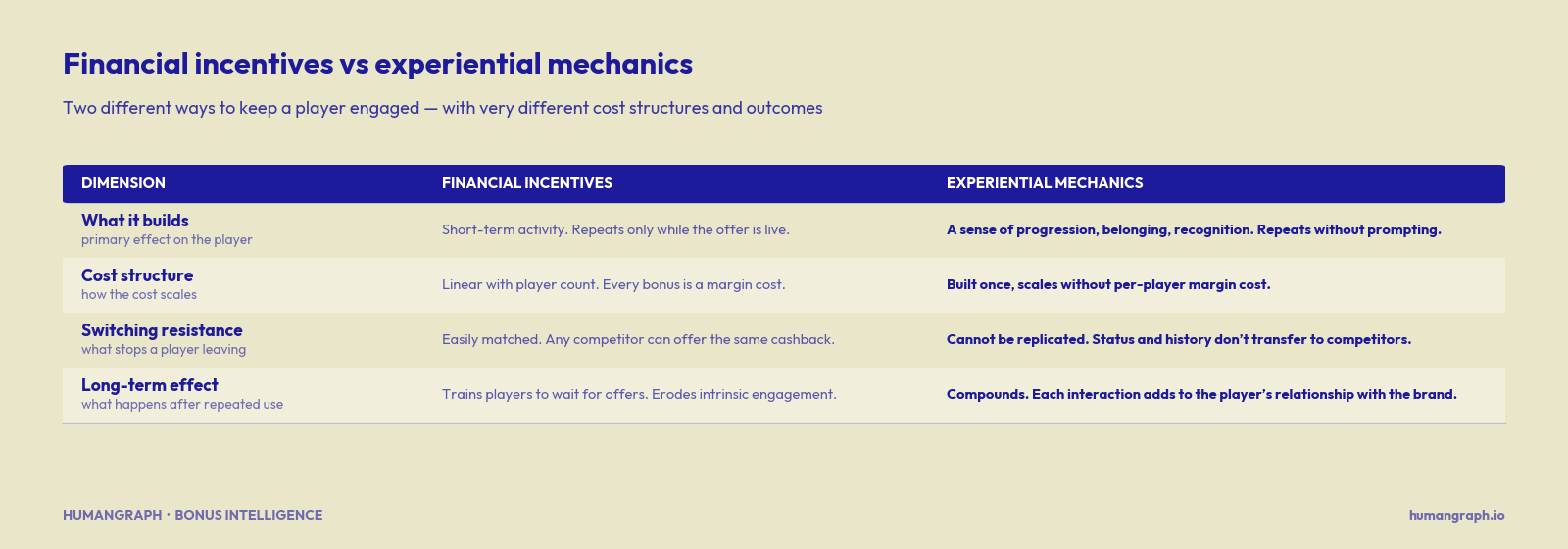
Status-based VIP recognition — covered in detail in The Competitor Exposure Window — builds switching resistance that cashback cannot replicate. A player who feels genuinely valued by a brand is harder to poach with a competitor’s welcome offer than a player whose entire relationship has been transactional.
None of this means bonuses disappear. It means they become one tool among several, used selectively rather than reflexively. The operators who use them best will be the ones who understand which tool fits which player at which moment — and have the intelligence to make that decision before the spend goes out the door.
6. From generous to intelligent
The era of aggressive, broad-based bonusing as a growth strategy is closing.
The economics no longer support it. Acquisition costs are high, margins are under pressure from competition and consolidation, and the players most easily attracted by large offers are often the least valuable in the long run. The operators that will manage bonus spend most effectively over the next five years are not those who can afford the biggest welcome offers. They are those who can answer three questions earlier than their competitors:
Which players genuinely respond to incentives in a way that improves their long-term value?
Which players are showing the early behavioural patterns of disengagement, when an intervention can still change the outcome?
Which players would have engaged regardless — and should be left to do so without the cost of an offer attached?
These are not questions that standard CRM reporting can answer quickly enough. They require earlier intelligence about player value and behaviour, built into the decision before the bonus is sent.
The right bonus, to the right player, at the right moment, is a different industry. The operators who get there first set the terms for everyone else.
We built HumanGraph to operate against exactly this problem. If the Generosity Trap is something you’d like to escape at your operation, we’d like to compare notes.