Most marketing budgets are decided before anyone knows what the players are worth.
Marketing leaders make scale, cap and budget decisions every week. The data that would tell them whether a campaign was worth it doesn't arrive for 90 days. The cost of that gap is structural — and it can be closed.

TL;DR — Marketing decisions move faster than player value becomes visible. By the time standard reporting shows whether a campaign was worth scaling, the budget has already been deployed for weeks. This article explains the Value Visibility Gap — the period between when a player’s eventual value is effectively decided and when it shows up in reporting — and how shifting from cost-based to value-based decisioning changes the economics of marketing in iGaming.
1. Where marketing decisions are made — and where value is decided
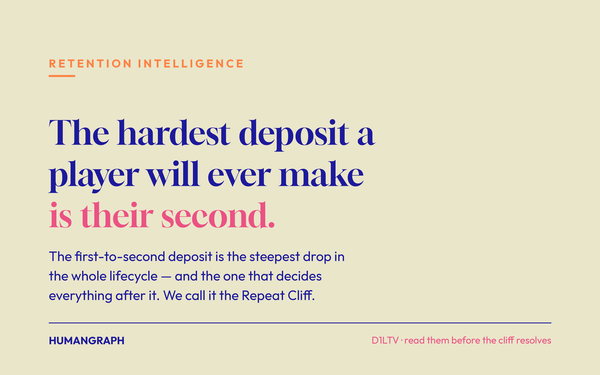
In the first three articles in this series (The Invisible Window, The Descending Curve, and The Competitor Exposure Window), we argued that the cost of acting late on player behaviour is structurally underestimated. The window to influence retention is narrower than CRM systems are built for, the recovery curve is steeper than reactivation playbooks assume, and the period when a future VIP can be identified is shorter than most operators are working inside.
The same timing problem exists at the front end of the player journey — but it shows up in a different place. Not in retention, not in VIP qualification, but on the desk of the CMO or Head of Marketing.
Marketing leaders are forced to make budget decisions every week. Scale this campaign or cap it. Reinvest in this channel or pull back. Pay this affiliate or renegotiate the deal. Approve a higher CPA in this market or hold the line. These decisions cannot wait for evidence. They have to be made with whatever information is available at the moment they are due.
But the information that would actually answer them — the eventual value of the players being acquired — does not become visible for 30, 60, or 90 days.
That mismatch is the central problem in marketing economics in iGaming. Budgets are decided weeks before anyone knows what the players are worth.
This is not a measurement problem. It is a visibility problem.
2. What the CPA snapshot can’t see
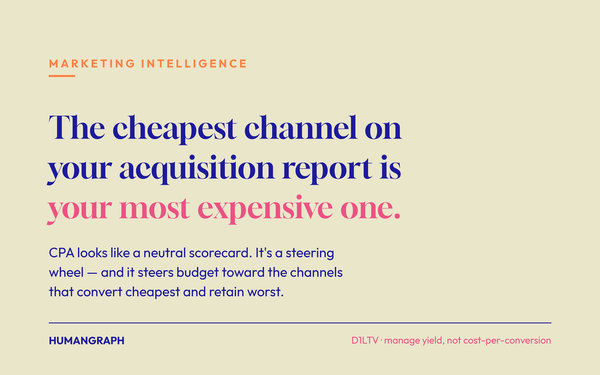
Cost per acquisition is the most readily available marketing metric. It is also, in isolation, one of the most misleading.
CPA tells you what a player cost. It tells you nothing about whether that player will recover the cost.
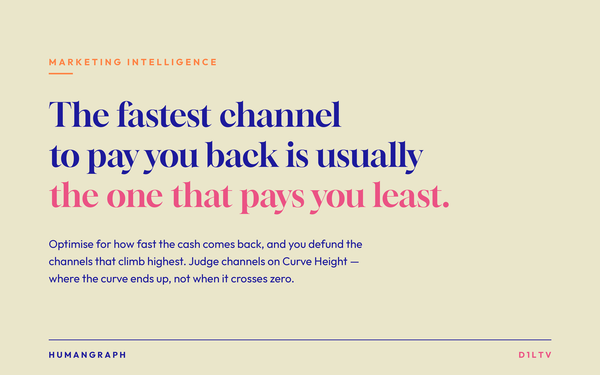
A campaign with a €40 CPA may look efficient and be structurally unprofitable — if the players it attracts churn before they generate enough revenue to repay the acquisition cost. A campaign with a €70 CPA may look expensive and be the strongest investment available — if the players it attracts develop into durable, high-value customers.
The metric and the truth are not the same thing.
This is well understood in principle. In practice, marketing decisions are made on CPA because that is the data that is available at the moment the decision is due. Long-term value data isn’t. So teams scale the campaigns that look cheap, cap the ones that look expensive, and discover months later which decisions were right.
Acquisition is easy to measure. Value is hard to see.
3. The Value Visibility Gap
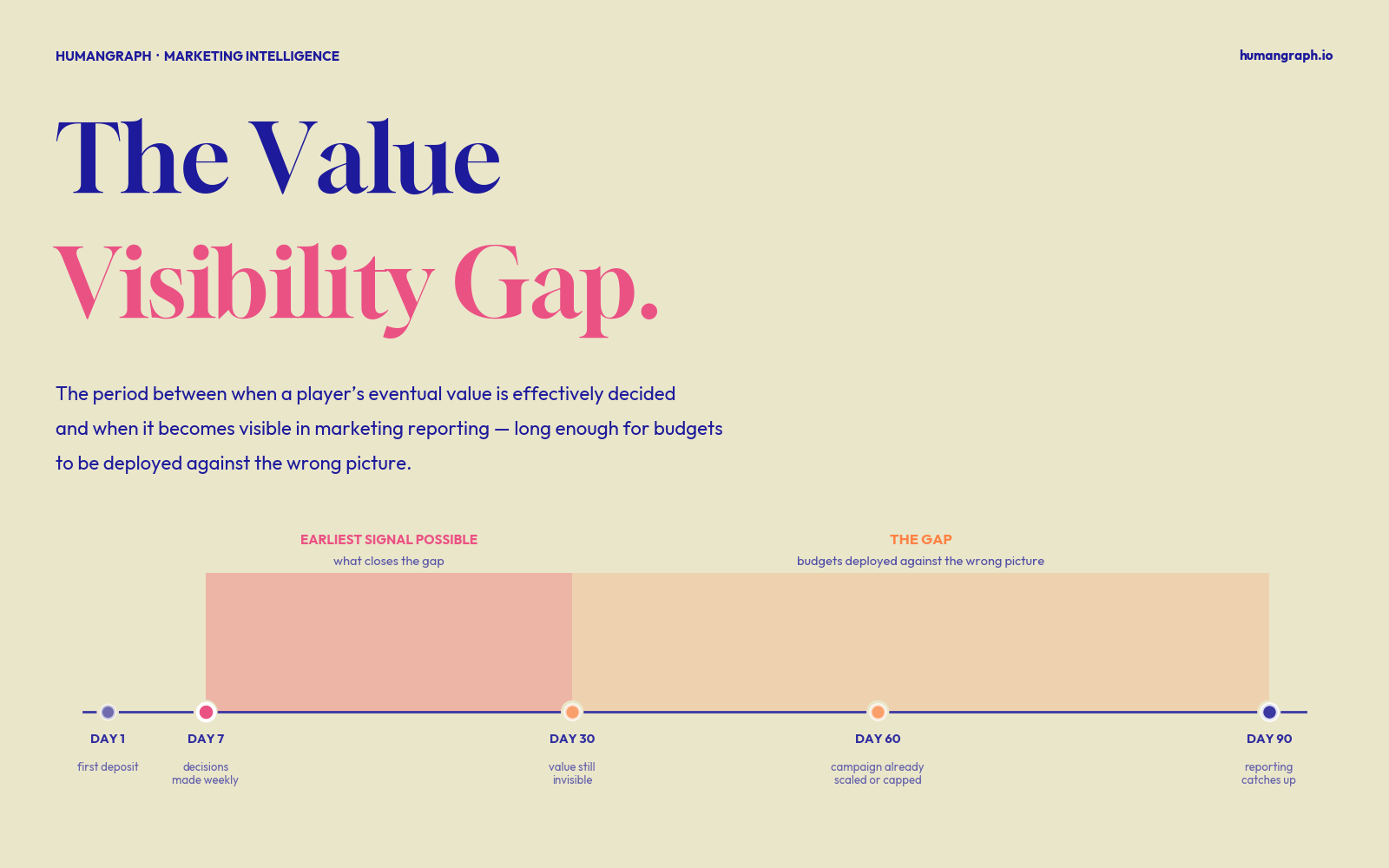
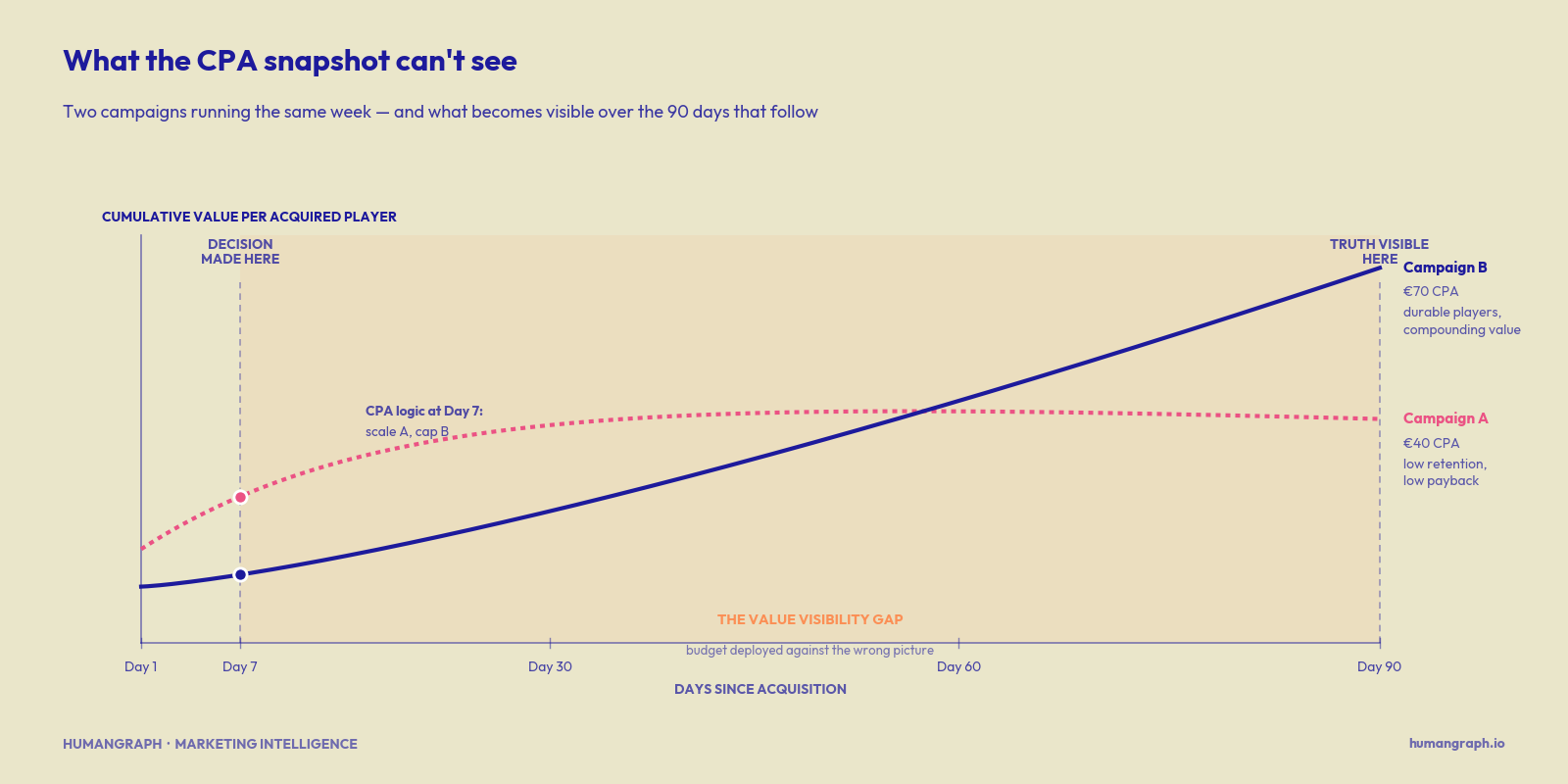
We call this the Value Visibility Gap — the period between when a player’s eventual value is effectively decided (in the first 1–7 days of behaviour) and when that value becomes visible in standard marketing reporting (typically 30–90 days later).
In that gap, marketing leaders are operating without the information that would let them decide whether a campaign is working. They are deciding based on CPA, registration volume, first-deposit count, and other early indicators that correlate weakly — or sometimes inversely — with what they actually care about.
Picture two campaigns running the same week.
Campaign A delivers a €40 CPA and high registration volume from a paid social channel. Campaign B delivers a €70 CPA and lower volume from a targeted partnership. On Week 2, the team is asked to decide which to scale and which to cap.
The CPA logic is obvious: scale A, cap B.
Over the next 60 days, the team continues feeding budget into Campaign A because the early indicators continue to look strong. Activity is high. First deposits are coming in. The campaign feels like it’s working.
By Day 90, the reporting catches up. Campaign A’s players have churned at well above average rates. Their average revenue per player is roughly a third of Campaign B’s. The cheaper campaign attracted bonus-driven, low-retention players who consumed promotional value and disappeared. The more expensive campaign attracted players who built habits, returned regularly, and have only just started generating the value they will eventually produce.
The team now knows. But the budget for the last 60 days has already been deployed on the basis of a picture that was wrong.
This is not an unusual scenario. It is the structural shape of marketing decisioning in iGaming whenever value visibility lags decision velocity. The longer the gap, the more often it happens, and the more it costs.
The frame is not just descriptive. It is diagnostic. If you can name the gap, you can ask the right next question: what would change if we could close it?
4. What changes when you can see value early
When marketing leaders can see the predicted value of the players each campaign is acquiring within days rather than months, four decisions change shape:
Scale-or-pause decisions stop being driven by CPA alone. A higher-CPA campaign with strong predicted value can be scaled with confidence; a low-CPA campaign with weak predicted value can be capped before further budget is committed. The decision is still made weekly — but with the information that would otherwise have arrived three months too late.
Channel-mix decisions become accountable to value rather than volume. A channel that delivers cheap traffic with weak predicted value should not be treated the same as one that delivers fewer, more durable players. The cheap channel may still earn its place — but its role in the mix gets defined by what it actually contributes, not by how many registrations it produces.
Bonus-allocation decisions sharpen. The same incentive offered indiscriminately to all new depositors costs the same in every direction. Offered selectively to the players with the strongest predicted long-term value, it earns much higher return. Lower-potential players move to lighter-touch journeys. Players showing the patterns that warrant responsible-gambling caution are flagged separately.
Affiliate-deal decisions gain a clearer basis. An affiliate delivering high registration volume but weak predicted value is not the same partnership as one delivering fewer but more durable players. The deal terms can reflect the actual economics — not just the volume curve.
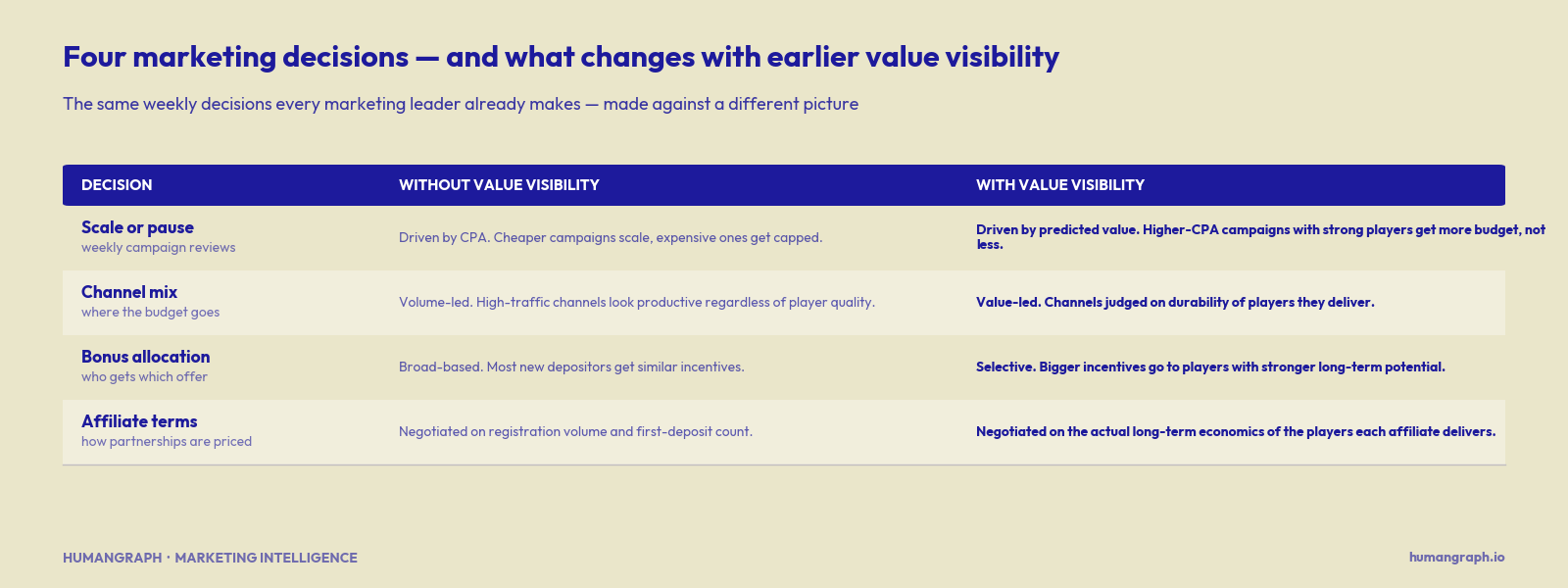
None of these decisions are exotic. They are the standard weekly decisions every marketing leader in iGaming already makes. What changes is the picture they are made against.
5. From engagement metrics to value metrics
Most marketing organisations measure performance through engagement: registrations, deposits, click rates, bonus uptake, reactivation rates. These metrics are useful, but they share a limitation. They measure activity, not outcome.
A campaign can generate strong engagement and weak economics. A reactivation push can bring back players who consume incentives and leave. A channel can deliver impressive volume that fails to convert into durable value. The engagement number looks healthy in every case — but the underlying economics may be deteriorating.
The next decade of marketing in iGaming will favour the organisations that can manage on outcome rather than activity. That requires earlier visibility into what each player is likely to be worth — which is a different capability from measuring what each player is currently doing.
This is the thinking behind D1LTV — Day-1 Lifetime Value Prediction — one of HumanGraph’s three core engines.
The shift is not from one metric to another. It is from CRM and marketing as messaging functions to CRM and marketing as value-management functions. The team’s job stops being to maximise engagement and starts being to direct spend toward the players who will most repay it.
6. The economics of knowing earlier
The constraint on marketing effectiveness in iGaming is no longer how much you can spend or how cheaply you can acquire.
Spend is abundant. Acquisition channels are commoditised. The activities that used to define competitive advantage — buying more traffic, offering bigger bonuses, paying higher affiliate commissions — are now table stakes. Every operator in your market has access to the same channels, the same bonus mechanics, and broadly the same data.
The constraint is how early you can see what you have bought.
The marketing organisations that will outperform over the next five years will not be those that spend the most. They will be those that close the Value Visibility Gap fastest — that can act on predicted value while their competitors are still waiting for revenue data to arrive.
When the cost of waiting is structural and the cost of seeing earlier is technical, the technical investment wins.
Marketing budgets get decided every week. The question is whether they are being decided in the dark.
We built HumanGraph to operate against exactly this problem. If the Value Visibility Gap is something you’d like to close at your operation, we’d like to compare notes.