Why your retention campaigns fire too late — and what to do about it
Most operator CRM systems detect churn after the player has already mentally checked out. Here’s why — and how leading indicators close the 5–7 day Invisible Window.


TL;DR — Most operator CRM systems detect churn after the player has already mentally checked out. This article explains the “Invisible Window,” why RFM-based segmentation misses it, and how leading indicators combined with a Fire and Smoke framework let you protect NPV and high-LTV players at the same time.
1. The “Retention Illusion” in modern iGaming
The industry has reached a point where high-volume, aggressive acquisition is no longer a sustainable engine for growth. As markets mature and regulation tightens, CPAs have climbed to levels that quietly cannibalise the LTV projections most cohorts were modelled on.
The frontier of profitability has moved. It is no longer the top of the funnel. It is the middle.
Retention is not a secondary administrative function — it is where the next decade of margin will be made or lost. And yet most operators are still operating under what we call the Retention Illusion: the belief that their CRM triggers are proactive when, in practice, they are post-mortem.
At the core of this failure is the Invisible Window. Standard dashboards monitor activity. They do not monitor intent.
Operator data consistently shows that the mental decision to churn happens significantly before the final session is logged. There is a gap — often five to seven days — where a player’s engagement trajectory has already collapsed while the system still labels them “active.” In that window, the player experiences friction, perceived lack of value, or a bad streak that goes unanswered. They mentally exit the platform long before they stop logging in.
When an operator waits for a “total inactivity” signal to fire, they are bonusing a ghost.
The player has already redirected their attention — and their wallet — to a competitor. The interventions are high-cost and low-impact because they try to reverse a terminal decision instead of preventing it. Closing this gap is now the most concrete way to protect Net Present Value (NPV).
2. The structural failure: Why RFM models look backward
A flawed yardstick produces flawed interventions. For decades, iGaming has leaned on Recency, Frequency, Monetary (RFM) models as the gold standard for segmentation.
RFM was useful for early digital marketing, but it is an accounting tool, not a predictive one. It measures what a player did. It does not measure what a player is about to do.
In the temporal dynamics of modern iGaming, relying on RFM is like driving a high-speed vehicle by looking through the rearview mirror.
The evolved framework is LRFMP — Length, Recency, Frequency, Monetary, Profit. The expansion matters. Profit (P) prevents the trap of treating a high-turnover, bonus-seeking player as high-value when their actual margin is negative. Length (L) lets the system distinguish between a long-term loyalist taking a natural break and a new user in terminal decline.
Without these two dimensions, two very different types of churn get treated with the same blunt instrument:
• Deliberate Churn — driven by dissatisfaction or competitive lure. Preventable if caught early.
• Incidental Churn — driven by external life changes such as relocation, career shifts, or financial pressure. Largely unpreventable.
Legacy RFM sees only “low recency” and fires panic-bonusing at both.
The result: operators over-incentivise loyal players during natural lulls (wasted margin) while completely missing high-value players whose trajectory is actually declining. By the time the Monetary or Frequency score drops far enough to alert the CRM team, the real fire has already consumed the relationship.
3. Decoding leading indicators: What early signal actually looks like
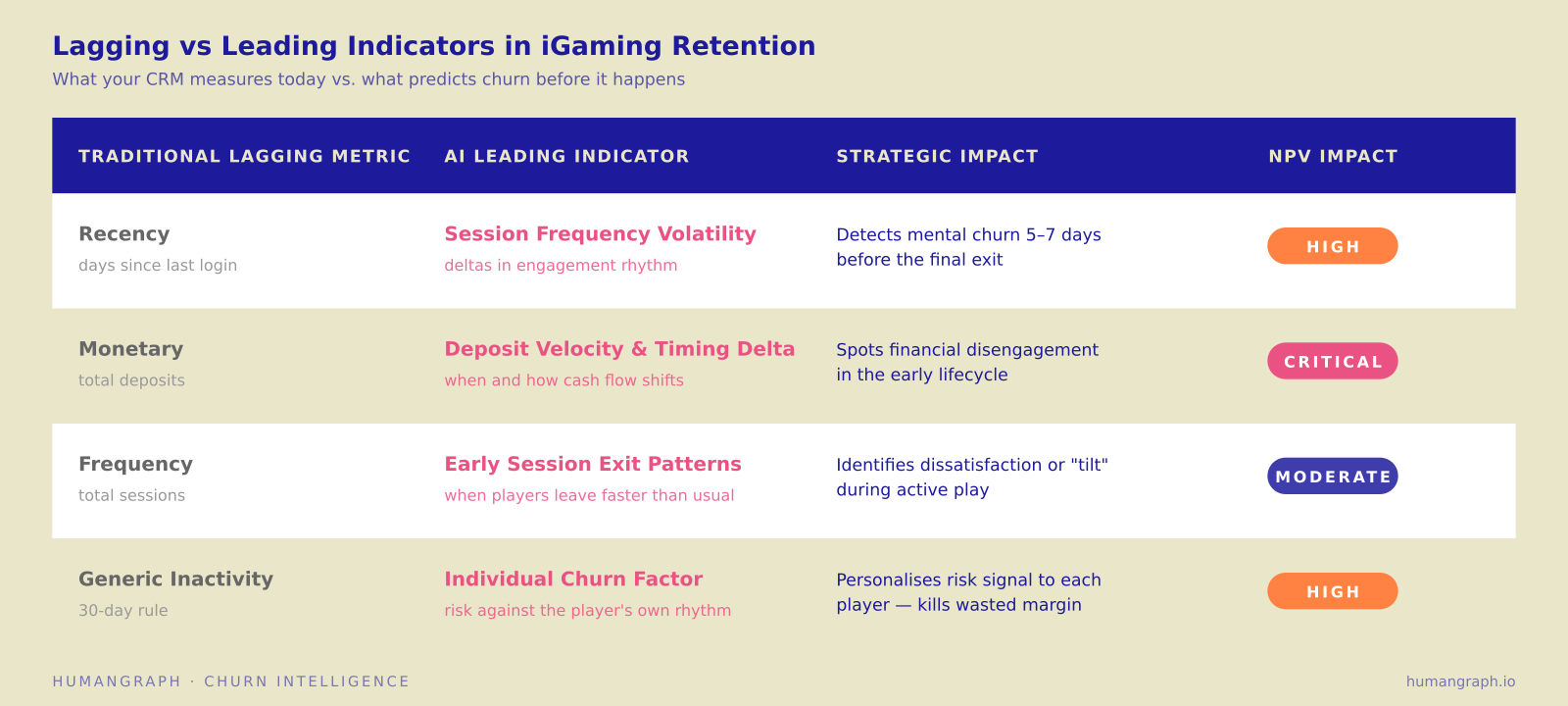
The transition from reactive to proactive requires detecting subtle behavioural shifts that show up well before the inactivity flag. These are not broad outcomes; they are deltas — changes in pattern over time. Time-series analysis isolates the specific behaviours that precede a total exit.
One of the most potent signals is the Session Frequency Delta. Instead of counting logins, the model analyses the volatility of engagement. A player who normally engages in high-intensity daily sessions and suddenly shifts to short, erratic bursts is fading. Interest leaks before the deposits do.
This is often accompanied by Early Session Exits — a player logs in but leaves significantly sooner than their historical average. Frequently a visceral reaction to a bad streak or a poor experience on the platform. If the system does not catch this “tilt” in real time, the window for an emotional save closes.
Deposit Timing Shifts in the first fourteen days of a player’s lifecycle are highly predictive of long-term LTV (Lifetime Value). A move from predictable, timed deposits to irregular, declining amounts is financial disengagement.
Picture a player who normally deposits €150 every Friday night. Over three weeks their deposits drop to €40, shift to mid-week, then stop. By the time the 14-day inactivity rule fires, the wallet has already moved to a competitor. The signal was visible by week two. The trigger was set for week three.
4. The Fire and Smoke strategy for resource allocation
Identifying a risk signal is only half the battle. The other half is the disciplined application of Generosity Scaling.
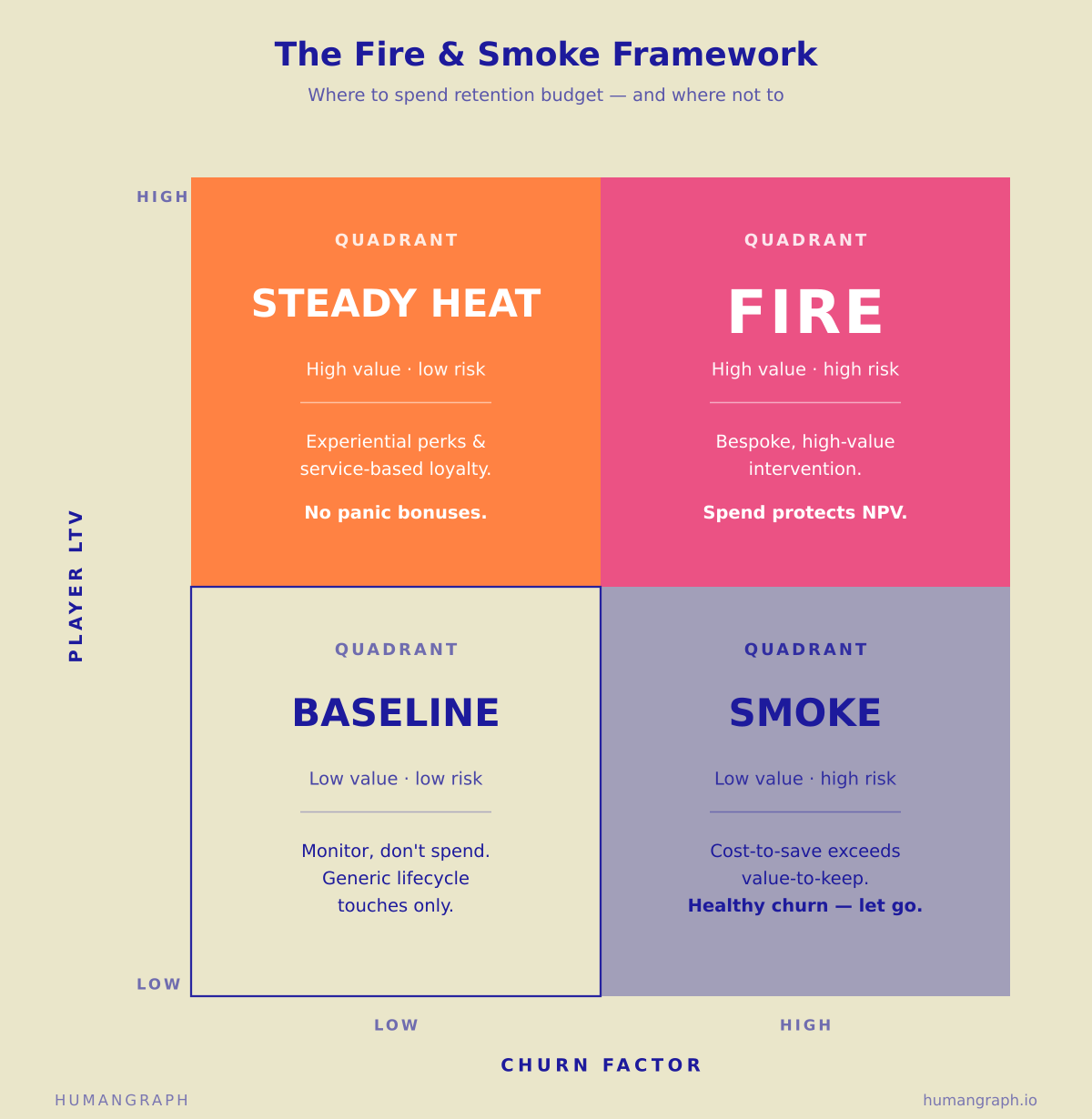
The primary threat to retention margin is bonus overuse. When every dip in activity triggers an automated high-value incentive, CRM stops being a retention engine and becomes a drain on profitability. The Fire and Smoke framework prevents this.
Fire is a high-LTV player exhibiting a high Churn Factor — a measure of current inactivity relative to that individual’s average rhythm. If a top-tier player who normally engages daily misses two consecutive days, their Churn Factor is significantly elevated. That is a real fire. The house is burning. A bespoke, high-value intervention is justified — not as a cost, but as an investment in protecting a significant asset.
Smoke is signal that looks urgent but carries no real impact on the bottom line.
Low-value bonus hunters with high churn risk fall here — the cost-to-save exceeds the value-to-keep. So do high-value loyalists who are simply within their normal window of inactivity. Panic-bonusing these players is a direct waste of margin: they were going to return anyway, and you have just trained them to expect a reward for their absence.
High-LTV players with low churn risk — what we call Steady Heat — should be transitioned away from costly bonuses toward experiential perks and service-based loyalty markers. This protects house margin while keeping the relationship warm through value-add rather than profit-sharing.
5. From manual CRM to advanced AI adoption
The fundamental limitation of classic CRM systems is flat-table logic. They see a snapshot of the player’s current state but are blind to the sequence of actions that led there.
No human team, however large, can manually calculate individual trajectories across thousands of players at the temporal resolution this work requires. This is where AI does the work humans cannot.
To handle the complexity of iGaming data, the right tools are ensemble methods and deep learning. Recurrent Neural Networks (RNNs) are particularly suited because they are designed to process time-series data — they analyse the sequence of logins, bets, and exits as a continuous narrative rather than isolated events.
The output is what we call a Predictive Lead Time: a churn probability on a 7-day horizon, available with the same clarity the operator currently has for a 30-day inactivity status.
This is the thinking behind COD — Churn Onset Detection — one of HumanGraph’s three core engines.
The model alone is not enough. AI is only useful if it is explainable. The CRM team must understand why a player has been flagged — was the trigger a Session Frequency Delta, a Deposit Timing Shift, or both? That explainability is what enables Generosity Scaling: the right incentive at the right time, not a blanket bonus.
In this model, the CRM department transforms from a cost centre that bonuses everyone into a profit driver that intelligently protects the operator’s most valuable assets. The AI handles high-frequency trajectory detection. The human layer retains the power of judgement.
6. Act on impact, not noise
The competitive edge in modern iGaming belongs to operators who recognise that the decision to leave is made long before the player stops logging in. Continuing to rely on backward-looking RFM and generic inactivity triggers is, in effect, handing margin to competitors who are better at reading the Invisible Window.
Maximising NPV and LTV requires a disciplined transition toward AI-driven leading indicators and the Fire and Smoke framework. Separate high-impact threats from low-impact noise. Scale generosity where it matters. Protect the most valuable players while keeping marketing budget surgical.
Move from constant, expensive panic to calculated, intelligence-driven growth.
We built HumanGraph to solve exactly this. If the Invisible Window is something you’re trying to close at your operation, we’d like to compare notes.