The cheapest channel on your acquisition report is usually the most expensive one on your P&L.
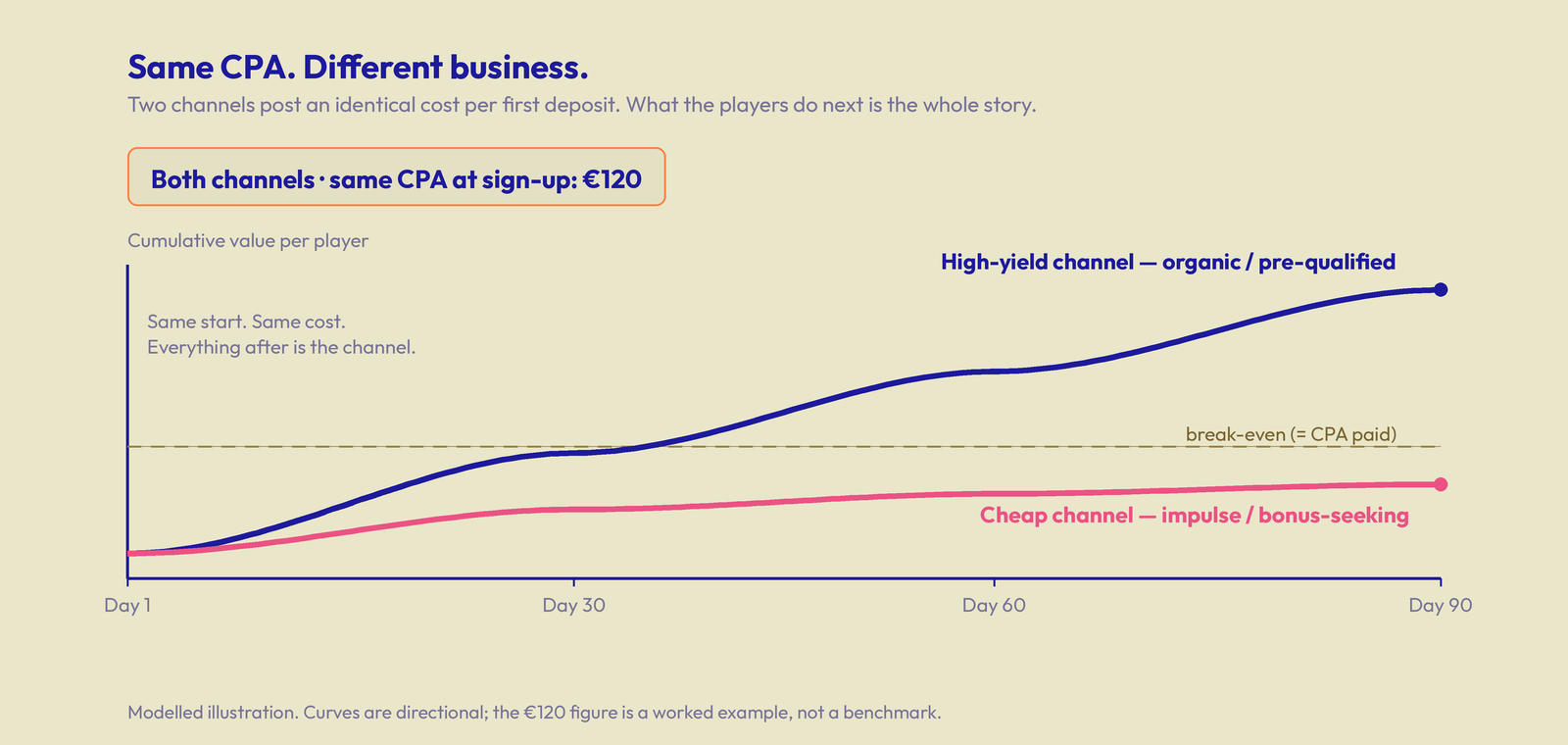
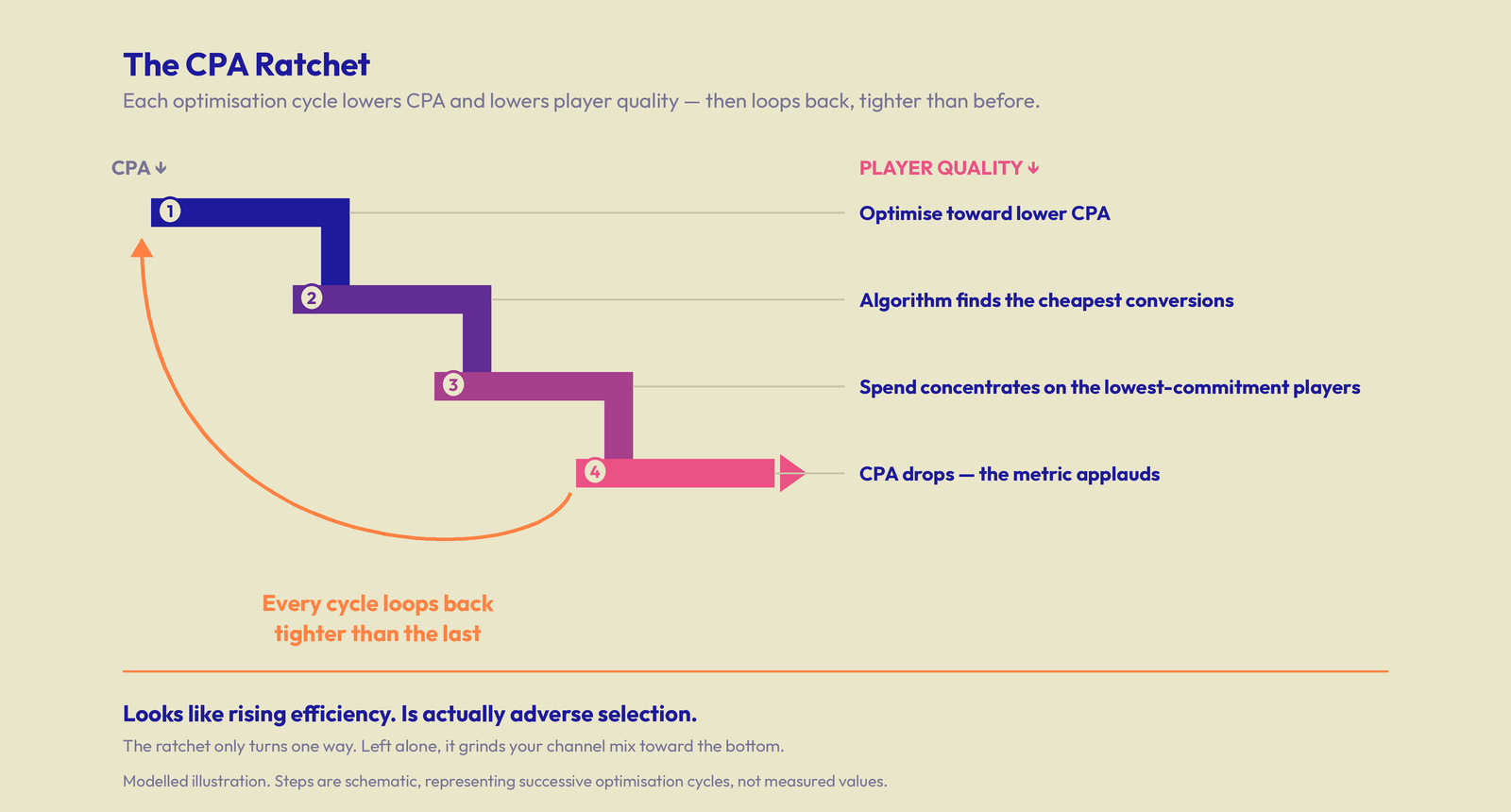
Two channels can post the same CPA and build completely different businesses. CPA-as-a-target chases the cheapest conversion and concentrates spend on the lowest-quality channels — the CPA Ratchet. The way out is Channel Yield.

TL;DR — Two channels can post the same CPA and build completely different businesses, because each one is a different funnel that selects a different kind of player. CPA-as-a-target makes this worse: bid algorithms chase the cheapest conversion, which concentrates spend on the lowest-quality channels and tightens with every optimisation cycle. We call that the CPA Ratchet. The way out is to manage channels on Channel Yield — what a cohort returns against fully-loaded cost — not on what each conversion costs at the point of sign-up.
In the earlier marketing articles in this series — The Value Visibility Gap and The Cold-Start Tax — we argued that the problem with CPA is timing: you commit budget weeks before player value becomes visible, and you act on the blank slate before you've read it.
There's a prior question underneath that one. Not when can I see what a channel is worth, but which channels are even capable of delivering value — and why the default metric quietly steers you away from them. That's a different problem, and it doesn't go away even if you fix the timing.
(Figures here are directional ranges drawn from modelled industry benchmarks, not precise values.)
1. The metric isn't watching your channels. It's choosing them
The comfortable view of CPA is that it's a measurement — a number on a dashboard that tells you what acquisition cost, after the fact, neutrally.
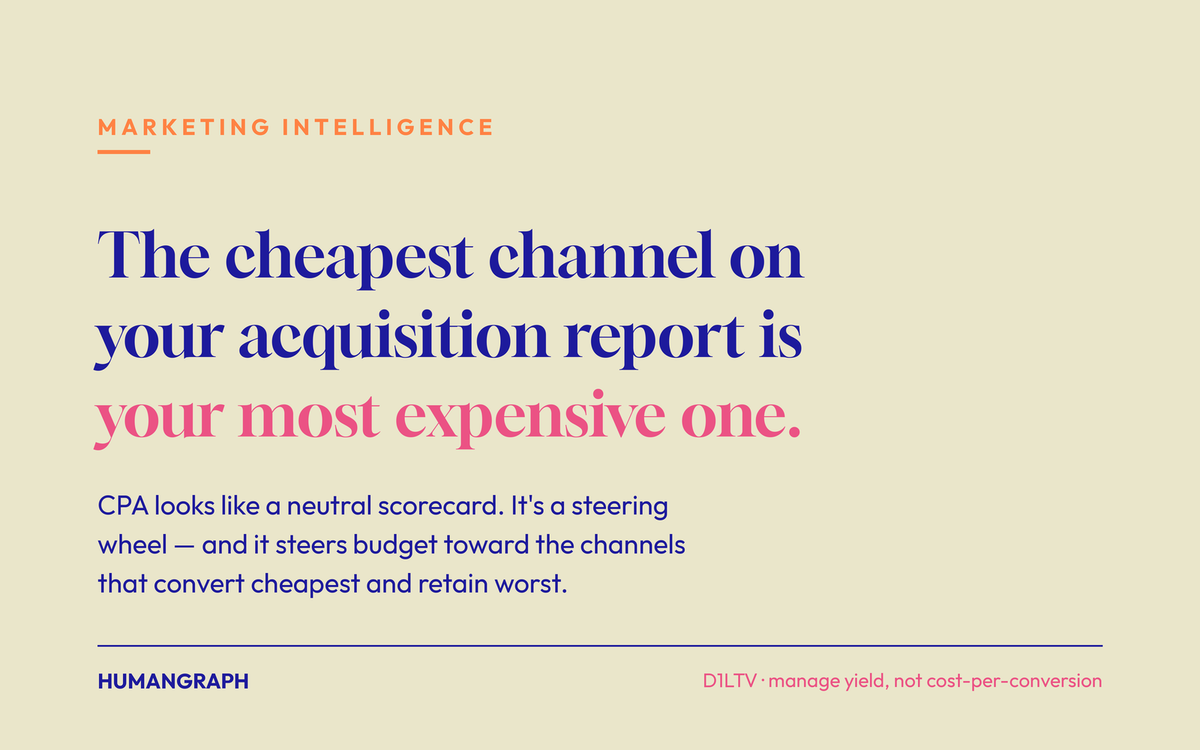
It isn't neutral, and it isn't after the fact. CPA is the target your acquisition stack optimises toward in real time. Every programmatic bid, every budget reallocation, every “scale this, cap that” decision is pulled toward whatever produces a first-time deposit for the least money. The metric you report on is also the metric the machine maximises — which means CPA isn't describing your channel mix. It's writing it.
A number that decides where your money goes is not a scorecard. It's a steering wheel, and most teams have their hands off it.
2. Same CPA, different players
The instinct is that two channels delivering FTDs at the same cost are the same deal. Identical price, identical product.
They are not, because a channel is not a neutral pipe. It's a filter that selects a particular kind of person. High-intent organic search captures players who were already looking — comparing brands, reading reviews, resolving their own friction before they ever register. Pre-qualified affiliate traffic does the same selection work upstream. At the other end, broad paid social and mini-app traffic capture impulse, novelty, and bonus-seeking — players who arrive cheap and leave fast.
The numbers underneath are not subtle. Organic search tends to convert at meaningfully higher rates than paid search, and pre-qualified affiliate players have been observed to generate multiples of the downstream value of general paid-search arrivals. At the low-commitment end, some of the cheapest-looking traffic posts eye-catching click-through rates and almost no durable deposits — first-deposit conversion that lands very low, a meaningful share of clicks that never represent a real player at all, and lifespans that rarely outlast a couple of months without heavy intervention. Same FTD on the acquisition report. Completely different player behind it.
A channel doesn't sell you conversions. It sells you a population — and populations don't cost the same to keep.
3. The CPA Ratchet
Here's where the steering wheel does real damage. When you optimise toward lower CPA, the system does exactly what you asked: it finds more of the cheapest conversions. The cheapest conversions come from the channels that select the lowest-commitment players. So budget flows toward them, their volume climbs, their cost-per-FTD drops further as the algorithm leans in — and the next optimisation cycle rewards them again.
This is the CPA Ratchet: a loop that looks like rising efficiency and is actually adverse selection. Each turn concentrates more spend on the channels producing the most disposable players, and the metric applauds every step, because every step did lower the cost per acquisition. The blended CAC on the monthly report keeps looking healthier while the cohort underneath it quietly rots — the cheap channel's bonus-hunters hidden behind the profitable organic stream they're averaged with.
The ratchet only turns one way. Left alone, it doesn't find equilibrium — it grinds your mix toward the bottom.
4. This is not the timing problem
It would be easy to read all this as another version of the Value Visibility Gap — you can't see value early, so you optimise on the wrong number until reporting catches up.
It isn't, and the distinction matters. The visibility gap is temporal: the truth exists, it just arrives late. The ratchet is structural: even with instant, perfect value visibility, CPA-as-a-target would still select the wrong channels, because it is optimising for cost per conversion and cost per conversion is inversely related to player quality across channels. Fixing your measurement latency doesn't disarm the ratchet. You have to change what the machine is pointed at.
A faster speedometer doesn't help when the wheel is turned the wrong way.
5. Channel Yield: the lens that breaks the ratchet
The fix is to stop managing acquisition on what a conversion costs and start managing it on what a cohort returns. Call it Channel Yield — the downstream value a channel's players actually produce, measured against the fully-loaded cost of acquiring them, not the media spend alone.
Yield reframes the whole comparison. The expensive channel that breaks even inside a quarter and compounds afterward is a better asset than the cheap channel that never reaches payback, regardless of how the CPA column ranks them. Healthy acquisition economics generally want a cohort that has repaid its fully-loaded cost well inside the first 90 days, and a lifetime-value-to-cost ratio comfortably above the widely-cited 3:1 floor — below roughly 2:1, scale only deepens the loss. The cheap channel that fails those tests isn't a bargain. It's a slow write-off with a flattering unit cost.
The obvious objection is the one this series keeps running into: payback takes weeks to confirm, and you allocate weekly. That's where early value scoring earns its place. This is the thinking behind D1LTV — Day-1 Lifetime Value Prediction, one of HumanGraph's three core engines: instead of waiting for a cohort's payback curve to mature, you score predicted value per channel from the first deposit and first sessions, and rank channels on projected yield while the budget decision is still live. The ratchet runs on cost because cost is the only number available in time. Give the system a value number in the same window, and you can point it somewhere better.
You can't break a loop by measuring it faster. You break it by changing what it optimises.
6. You're not buying conversions. You're buying revenue
The cheapest acquisition feels like a win because the cost is the part you can see at the moment you pay it. The revenue is the part you can't — so it loses the argument every time the two are weighed at sign-up.
But you were never buying conversions. You were buying the future revenue those players will or won't produce, and the channel you bought them through has already largely decided which. The acquisition report ranks your channels by the one number that is inversely correlated with the thing you actually wanted. Managing to it doesn't make acquisition efficient. It makes it efficiently wrong.
Two channels can post the same CPA and build completely different businesses. The only question that matters is which business you're funding — and the cost column on your acquisition report is the last place that answer will show up.
Where promotional spend fits into this — and why bonus-led channels flatter their own CPA — is the territory of The Generosity Trap. We built HumanGraph to operate against exactly this kind of problem. If the CPA Ratchet is something you'd like to break at your operation, we'd like to compare notes.