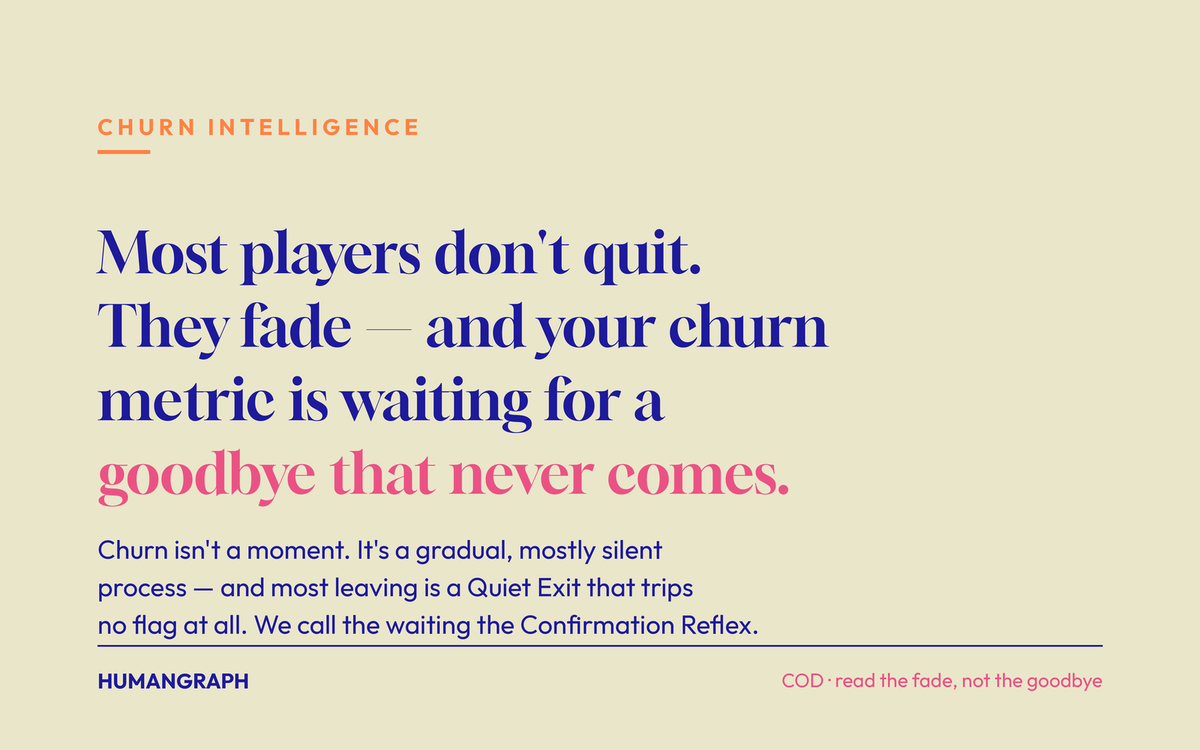
Most players don't quit. They fade. And your churn metric is waiting for a goodbye that never comes.
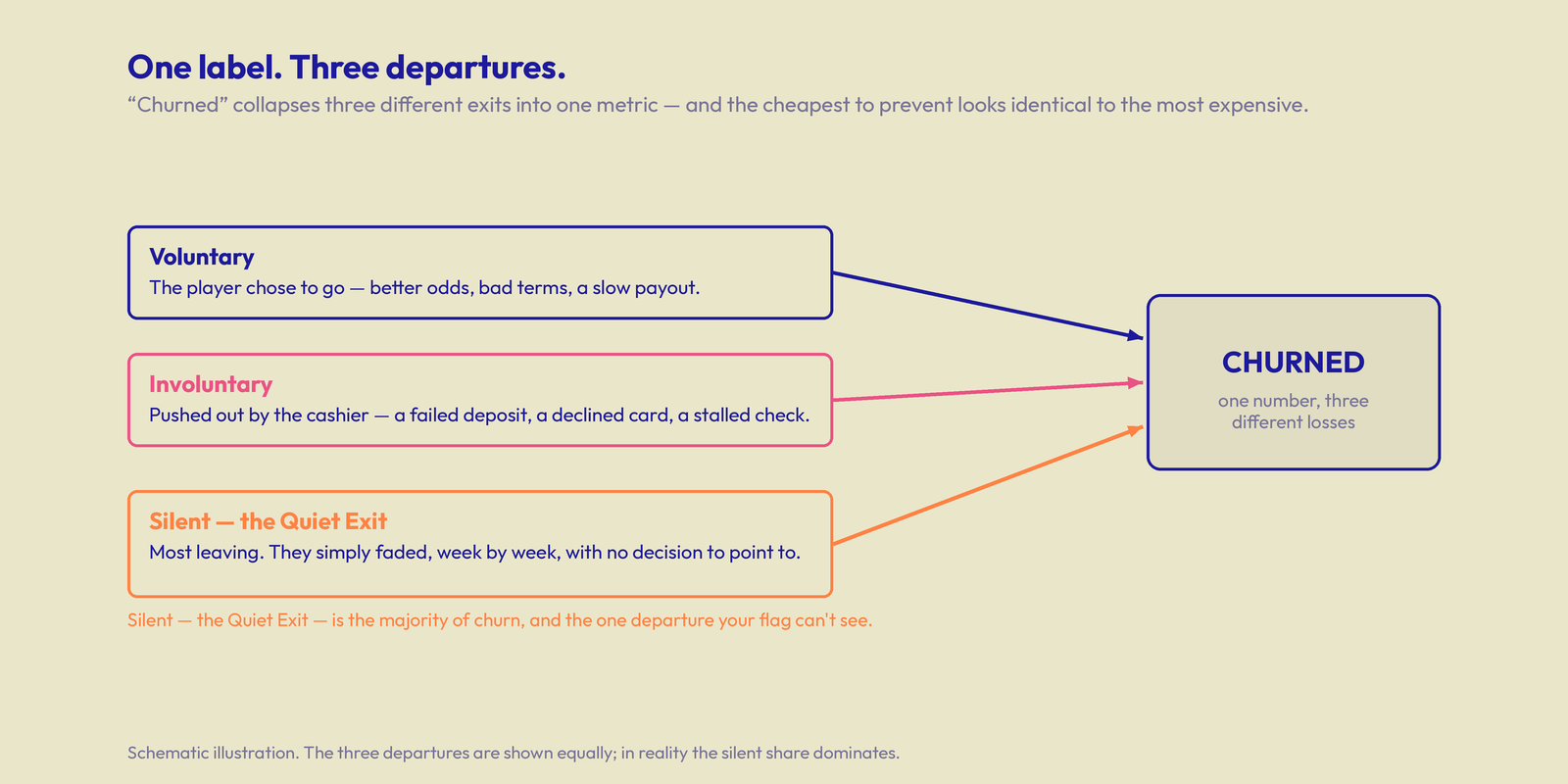
“Churn” is one word for three different ways of leaving — voluntary, involuntary, and silent. The overwhelming majority is silent, tripping no flag at all. We call it the Quiet Exit, and the habit of waiting for a clean after-the-fact line the Confirmation Reflex.

TL;DR — “Churn” is one word for three different ways of leaving: voluntary (the player chose to go), involuntary (the cashier pushed them out), and silent (they simply faded). The overwhelming majority is silent — no complaint, no closure, no event — which means the most common form of churn trips none of the flags built to catch it. We call that the Quiet Exit. Systems default to a clean, after-the-fact churn line anyway, because it's tidy, auditable, and fits the architecture — the Confirmation Reflex — and that tidiness is exactly what guarantees you only ever see churn once it's complete. Treating leaving as a process you can watch, rather than an event you record, is where everything downstream starts.
In The Descending Curve and The Invisible Window we made the timing case for churn: recovery probability decays sharply with every day of absence, and most CRM systems only notice a player is leaving after they've mentally gone. Both took as given the thing worth examining directly — what churn actually is.
Because if churn is an event, you flag it and react. If it's a process — and it is — you have to understand its anatomy before any of the detection or economics make sense. That's what this article is about.
(Figures here are directional ranges drawn from modelled industry and cross-sector benchmarks, not precise values.)
1. “Churned” is one label for three different departures
The intuition behind every churn dashboard is that a player has a state — active or gone — and a threshold tells you which one. Cross the line, change the label, move them to the win-back list.
That single label hides three completely different things. Some players leave on purpose: they found better odds, got tired of the wagering terms, or were burned by a slow payout. Some are pushed out without choosing to go: a deposit that failed, a card the issuer declined, a verification step that stalled at the worst moment. And some — most — simply fade, reducing their play week by week until there's nothing left, never making a decision you could point to. One metric, three departures, and the cheapest one to prevent looks identical to the most expensive one on your report.
A number that can't tell the difference between a player who quit, a player you lost, and a player who drifted isn't measuring churn. It's just counting absence.
2. The Quiet Exit
The assumption baked into a churn flag is that leaving produces an event — a closed account, a complaint, a clear break the system can catch.
In a non-contractual business, it usually doesn't. A player owes you nothing, signed nothing, and pays no price for keeping a funded account they never touch. So when they go, the overwhelming majority go silently — across digital businesses, the share of customers who leave without ever complaining or formally quitting runs close to the whole. They don't slam a door. They stop logging in on Tuesday, play a little less the week after, skip the weekend they'd normally never miss, and one day they're simply not there. This is the Quiet Exit: the dominant form of churn, and the one your flag is structurally incapable of seeing, because it's waiting for an event the player never generates.
Most of your lost revenue doesn't walk out. It evaporates.
3. The leaving you never caused
It's natural to read churn as a verdict on the product — the player left because a competitor was better, or because something went wrong. Lose the player, find the flaw.
A large share of churn isn't a verdict at all. It's involuntary — players who wanted to stay and couldn't, removed not by a decision but by friction. A deposit fails and they assume the offer expired. A card gets declined by an overcautious fraud filter and they don't try a second time. A withdrawal stalls behind a verification step and the trust quietly breaks. In digital subscription businesses, payment failures alone account for a fifth to two-fifths of all churn, and iGaming inherits the same leak through its cashier. These are satisfied players, lost to plumbing — and because they never complained either, they show up in your numbers as exactly the same Quiet Exit as everyone else.
Some of your most preventable churn isn't a player rejecting you. It's a player who couldn't reach you and gave up trying.
4. A fade leaves a trail, even when it leaves no event
If most churn is a silent fade with no closure, no complaint, no decisive break, the natural conclusion is that there's nothing to catch — silence is the absence of anything to act on.
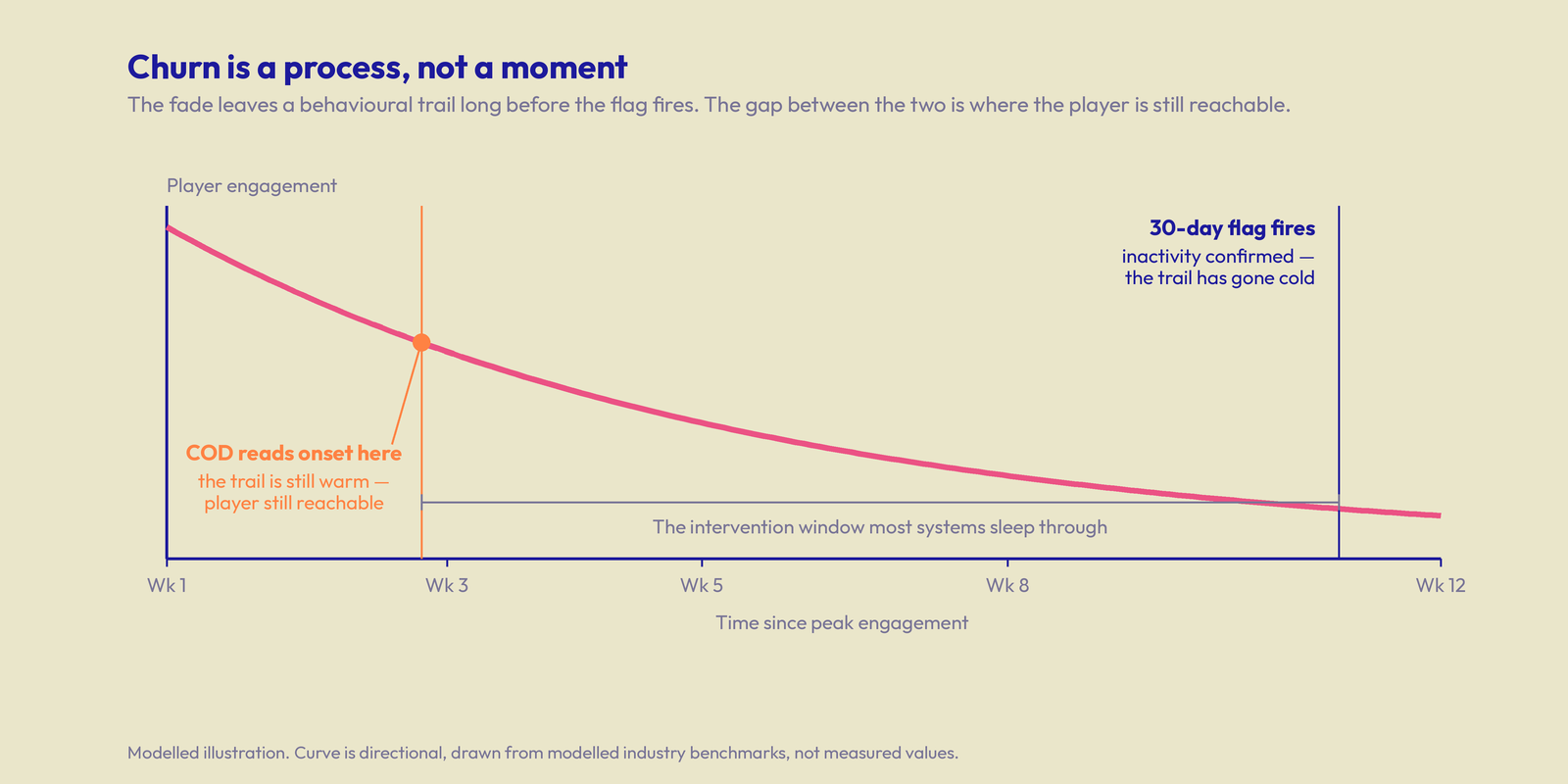
That conflates two different things. The Quiet Exit produces no event — but it is not the absence of behaviour. A player who is fading is still depositing, still logging in, still doing things; they are simply doing less of them, in a changing shape, on the way down. The leaving generates no single moment to flag, but it leaves a continuous trail in what the player actually does. Silence, here, is a property of your trigger, not of the player. They never went quiet. Your system was only built to hear one sound — the absence of all of them — and by the time it hears that, the trail has already run cold.
This is the gap COD — the Churn Onset Detector, one of HumanGraph's three core engines, is built to close: instead of waiting for an inactivity line to confirm a departure that left no event, it scores the onset of disengagement continuously, reading the trail as it forms rather than the silence at the end of it. Exactly which behaviours mark that trail — and the gap between when a player mentally leaves and when the flag fires — is the territory of The Invisible Window. The point here is the one prior to it: a departure that triggers no event is not a departure you cannot see.
A player going quiet is not a player going dark. Your system just turned off the lights too early.
5. The Confirmation Reflex
The easy assumption is that the 30-day churn line is a harmless reporting convention — a way to put a number in a deck, nothing more.
It isn't harmless, and it persists for reasons that have little to do with accuracy. A clean binary threshold is auditable, fits a spreadsheet, gives a board a countable figure, and runs comfortably on the overnight batch architecture most player systems were built around. A continuous, daily-updating risk gradient does none of those things easily — it demands real-time data, unified stacks, and a tolerance for probability over certainty. So the tidy metric wins by default, not because it's right. This is the Confirmation Reflex: the institutional preference for a churn definition you can confirm cleanly after the fact, over one you can act on messily in the moment. And the reflex has a cost built into it — a metric designed to be confirmable is, by construction, a metric that arrives after there's anything left to do.
The tidy number isn't the cheap option. It's the most expensive one, dressed as good governance.
6. You can't intervene in a verdict
Most retention effort lands on the far side of the process — win-back campaigns aimed at players the fade already finished taking. It's the logical place to act if churn is an event, because the event is the only thing the system ever surfaced.
It's the wrong place if churn is a process. By the time a player clears the churn line, the leverage is mostly spent: the Descending Curve has already done its damage, the relationship is cold, and what's left is an expensive, low-yield reactivation attempt against a player who's likely playing somewhere else. The leverage was upstream, during the fade, when the player was still ambivalent and still reachable — and early retention, caught at onset, costs a fraction of a win-back for a fraction of the margin damage. Treating churn as a verdict means you only ever spend where the returns are worst.
The shift is small to state and structural to do: stop counting the players who already left, and start watching the ones who are leaving. The first is a number. The second is a chance.
We built HumanGraph to operate at the onset, not the aftermath. If catching the fade while it's still reversible — rather than confirming it once it's done — is something you'd like to act on at your operation, we'd like to compare notes.