Why most retention budgets reach the wrong players — and what changes when you act earlier
Most CRM systems wait for silence before acting on retention. By then, recovery has multiplied in cost and the players still worth saving have moved on. Here's the Descending Curve — and what acting earlier looks like in practice.

TL;DR — Player recovery probability does not decline gently after disengagement begins. It collapses. By the time most CRM systems detect that a player has churned, the window where intervention was both cheap and effective has already closed. This article explains the Descending Curve, why retention budgets reach the wrong players, and how shifting decision timing from absence-detection to onset-detection rebuilds the unit economics of retention.
1. The retention paradox in modern iGaming
In iGaming, retention has always been difficult.
Players move quickly between brands. Products look similar. Promotions are easy to copy. With switching costs effectively at zero, loyalty is fragile by design.
Most operators understand this. They invest in CRM tooling, loyalty mechanics, VIP programmes, and bonus engines. The budgets are allocated. The teams are working. And yet retention remains one of the hardest commercial problems in the business.
The reason is not lack of investment. The deeper issue is that the systems built to handle retention are oriented toward the past. They detect what already happened. They act on what they can already see.
By the time most systems flag a player as at risk, the most valuable window to act has already closed. The campaign fires, the bonus lands, the email is opened — and none of it changes the outcome, because the decision was made days or weeks before.
This is not a CRM tooling failure. It is a timing failure.
2. The Descending Curve
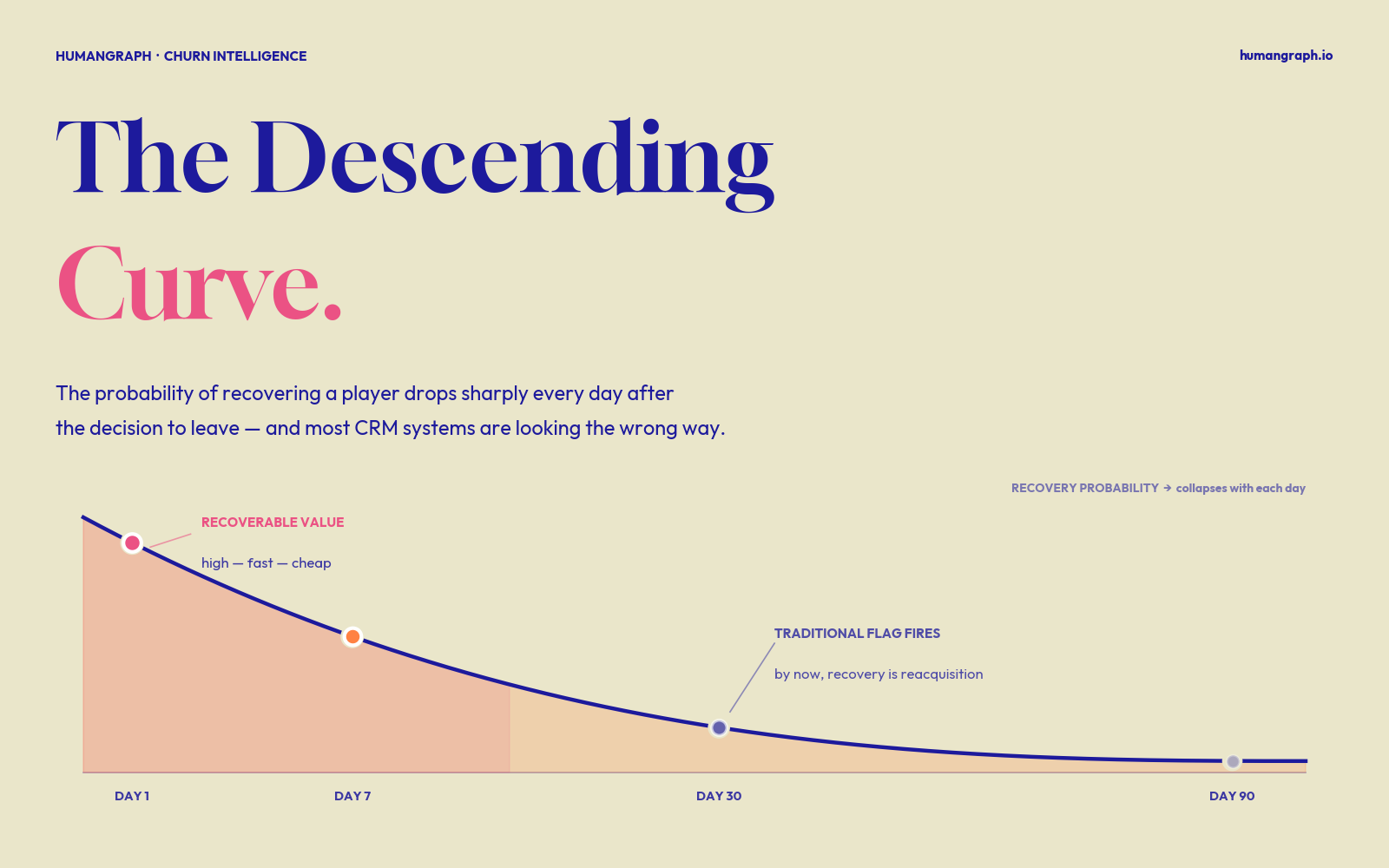
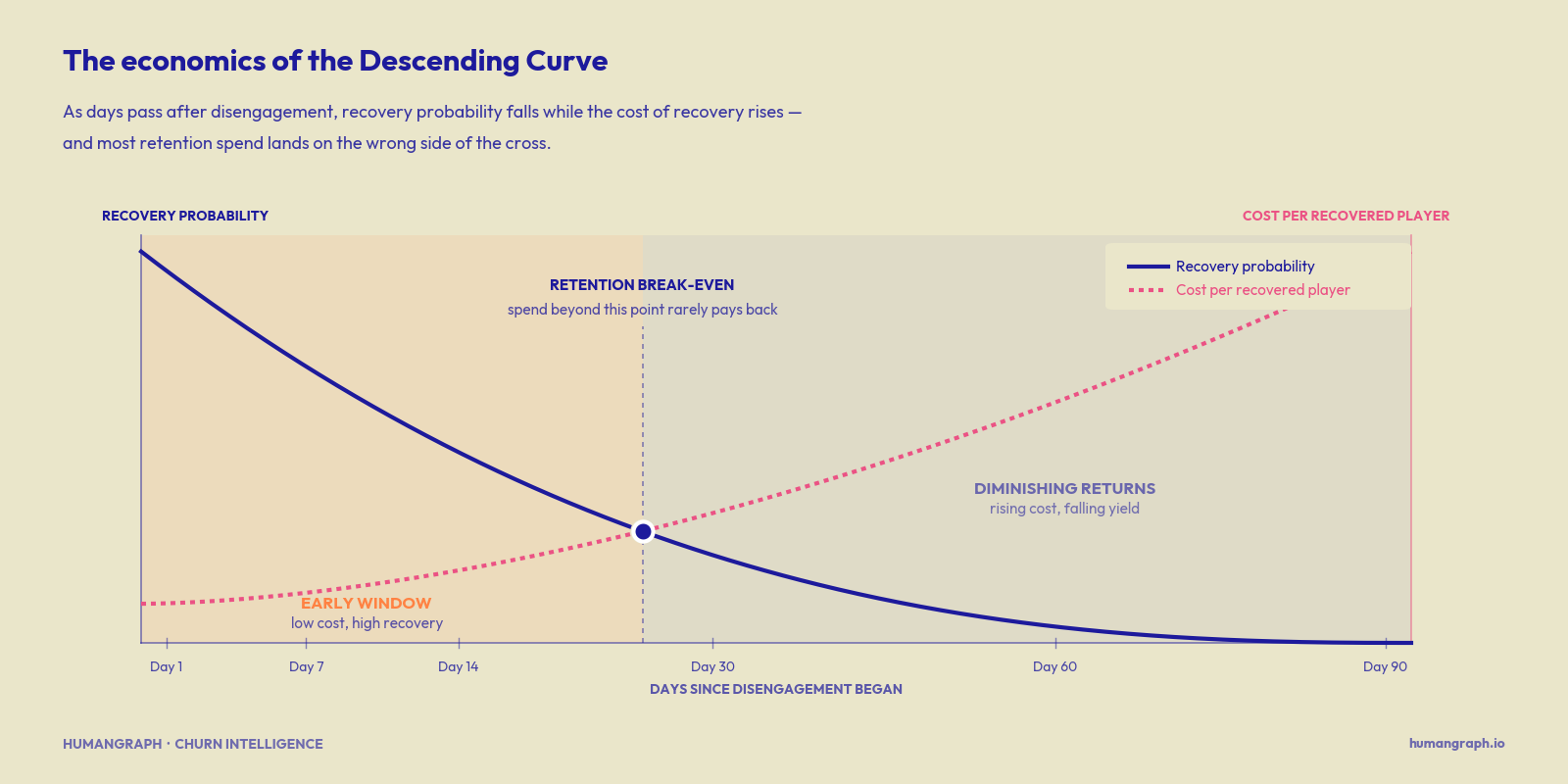
When a player begins to disengage, recovery probability does not decline gently. It descends sharply — and the shape of that descent is the single most important variable in the economics of retention.
We call this the Descending Curve.
On Day 1 after a player’s last meaningful session, the relationship is still warm. The brand is still the default. The next deposit is a habit, not a decision. A low-cost intervention — a personalised push, a small contextual offer, a VIP host reaching out — has a real chance of restoring the rhythm.
By Day 7, that probability has dropped meaningfully. Competing apps on the player’s phone have had a week of unopposed attention. The competitive context has changed. The intervention now needs to be more substantial to land — and it lands with a player who is no longer paying full attention to your brand.
By Day 30 — the moment most CRM systems traditionally flag inactivity — recovery is fundamentally a different commercial problem. The probability of meaningful long-term re-engagement is low. The cost of the incentive required to even generate a session is high. The player who returns at this point typically does so at a fraction of the lifetime value they would have produced if intercepted earlier.
By Day 90, you are no longer doing retention. You are doing reacquisition, against a brand that has already chosen a competitor — and the economics reflect that.
The curve does not stop descending after the player is “lost.” It just stops being commercially relevant.
3. What changes before the flag fires
The reason timing matters so much is that disengagement is not a sudden event. It is a gradual shift — and the shift is visible in operator data 7 to 14 days before traditional metrics flag it.
The early indicators are not in win/loss data. They are in the rhythm of how a player interacts with the platform.
Session cadence is one of the most reliable. A player who typically logs in four times a week moving to once is showing a meaningful change. The widening gap between sessions is often more predictive than the total number of sessions — an expanding gap suggests the player is exploring alternatives or losing their habitual connection to the brand.
Deposit timing is another. A player who deposits every Friday missing a week, or reducing deposit sizes while still active, is winding down commitment quietly. Picture a player who normally deposits €100 every Saturday night. Over three weekends, the deposits drop to €30, shift to Wednesday afternoons, and then stop. By the time the 30-day inactivity rule fires, the wallet has been with a competitor for nearly a month. The signal was visible by the second weekend.
Product narrowing tells a similar story. A player who previously moved between several game categories suddenly confining themselves to one is showing reduced engagement with the platform’s wider ecosystem. Login-time shifts matter too: a player who moves from peak-hour social play to late-night isolated sessions is often showing a change in psychological context that precedes departure.
None of this requires exotic data. It requires reading the data the operator already collects with a model designed for sequence and rhythm — not for snapshot.
4. Where the retention budget actually goes
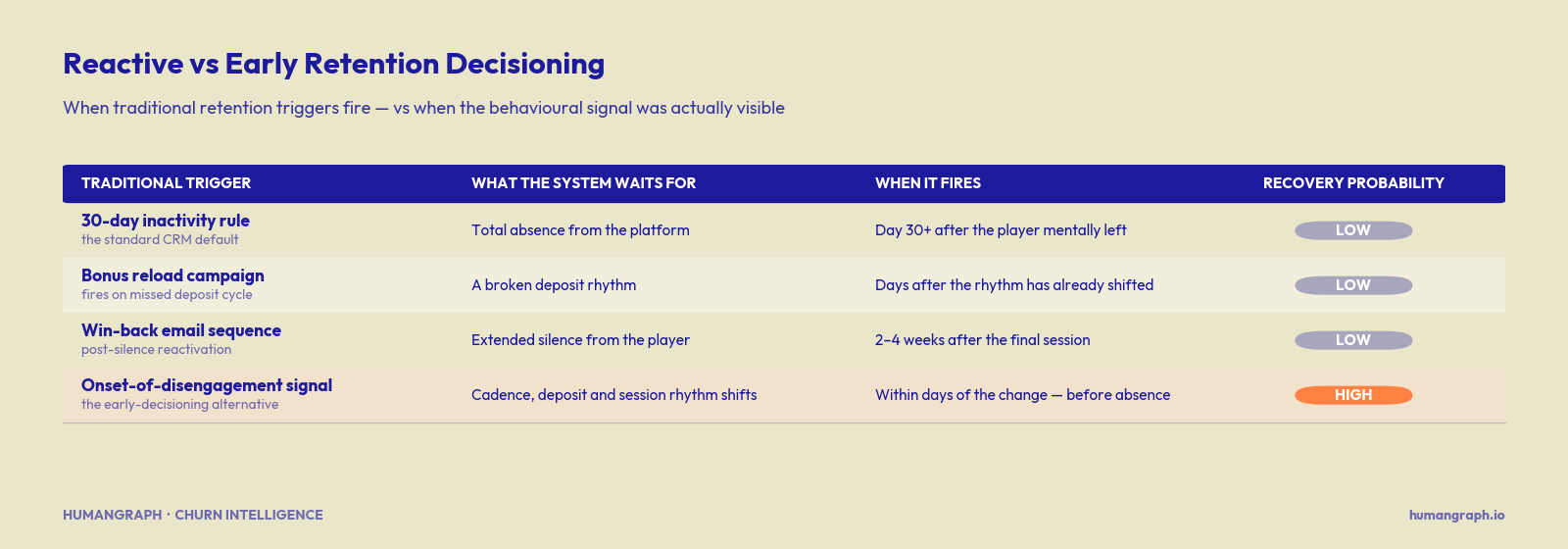
Retention bonus budgets in iGaming are substantial. A meaningful portion of that spend is not creating retention value — it is leaking in two directions at once.
The first leak is the organic player — someone who would have returned regardless. Sending them a retention offer is not retention spend. It is margin given away. A reload bonus that lands the day before a player was going to deposit anyway converts a high-margin session into a low-margin one, and trains the player to expect rewards for behaviour that needed no intervention.
The second leak is the player who has already mentally left. A win-back offer sent two weeks after the decision was made does not reverse that decision. It may generate a short, defensive session, but the probability of meaningful long-term re-engagement is low, and the cost of the incentive required to even produce that session is high.
The commercial question worth asking is not “who has been inactive for thirty days?” It is: which players are genuinely at risk, have genuine long-term value, and are still reachable at a moment when a low-cost intervention can change their behaviour?
That is a different question. It has a different answer. And it produces a different shape of retention spend — concentrated on the players where intervention timing still matters, withdrawn from the players where it does not.
This is the discipline we referred to in The Invisible Window as Generosity Scaling. It only works if the system is reading early signals, not absence.
5. From reactive reporting to early decisioning
The traditional retention model is built around a sequence that starts too late: the player becomes inactive, the system flags them, a campaign fires, and the team tries to recover the relationship.
The more effective model inverts the sequence. Behavioural rhythm shifts. The system detects the change before absence. The player is prioritised based on their predicted value, their current risk level, and how reachable they still are. The team — or an automated workflow — chooses a response while the outcome is still changeable.
This shift does not require replacing CRM, loyalty programmes, or responsible gambling workflows. It requires acting on earlier information so those tools are deployed at the moment they can actually work.
The systems that enable this are built on real-time event streaming rather than nightly batch processing. They maintain a live view of player state — not last week’s session summary, but what is happening in the current engagement cycle. They produce a churn-onset probability with the same operational clarity that operators currently have for a 30-day inactivity status — except weeks earlier.
This is the thinking behind COD — Churn Onset Detection — one of HumanGraph’s three core engines.
What this enables in practice is straightforward: the campaign that used to fire on Day 30 fires on Day 7. The bonus that used to be a reload becomes a contextual nudge. The VIP host calls while the player is still listening. The cost per save drops because the intervention is lighter. The yield per save rises because the relationship is still warm.
The system does not need to be perfect to be transformative. It needs to be earlier.
6. Operate earlier, or absorb the cost
In a market where switching takes minutes and players routinely maintain accounts with several brands, the window for retention intervention is short and shrinking.
The operators who manage retention most effectively are not those sending the largest bonuses or running the most campaigns. They are those who understand behavioural change earliest — who can see the beginning of disengagement before it becomes absence, and respond while there is still a relationship to protect.
Retention does not begin when a player disappears. It begins when their behaviour first starts to change. Everything that happens after absence is recovery — which is harder, more expensive, and progressively unlikely to succeed.
The commercial advantage belongs to the teams that never have to get there.
We built HumanGraph to operate against exactly this problem. If the Descending Curve is something you’d like to act against rather than absorb, we’d like to compare notes.