The hardest deposit a player will ever make is their second.
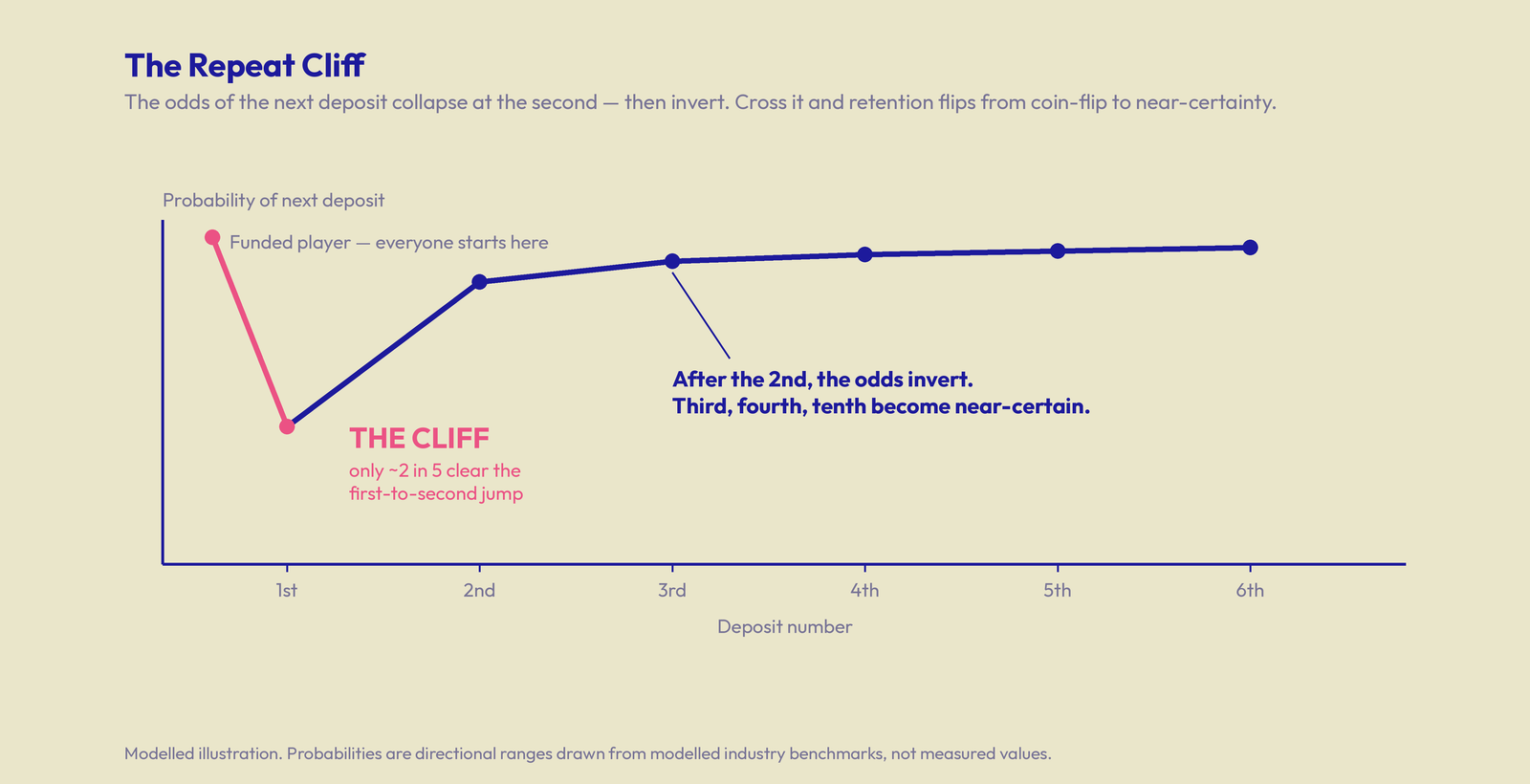
The first-to-second deposit is the steepest drop in the whole lifecycle — roughly four in ten never make it. But the odds invert the moment it's crossed. We call that asymmetry the Repeat Cliff, and the narrow window to cross it the Incubation Clock.

TL;DR — The first-to-second deposit is the hardest transition a player ever makes: roughly four in ten never make it. But it's also the most decisive, because the odds invert the moment it's crossed — a player who deposits twice is dramatically more likely to deposit a third, fourth, and tenth time. We call that asymmetry the Repeat Cliff. The window to get a player across it is narrow — most second deposits land inside the first month — and how fast they cross grades how durable they'll be. We call that window the Incubation Clock. Most operators spend it waiting.
In The First 14 Days we drew the Second-Deposit Line — the threshold that actually separates a retained player from a one-and-done, and the real finish line the first deposit is so often mistaken for. That article established where the line sits. This one walks up to it and looks at what happens when a player crosses it — and why crossing is so much harder, and so much more decisive, than anything that comes before.
(Figures here are directional ranges drawn from modelled industry benchmarks, not precise values.)
1. A funded player is not yet a customer
A new player who has registered, deposited, and started playing looks like a customer. The acquisition worked. The wallet is funded. The product is in their hands.
They are not a customer yet. They are an unresolved bet. Until the second deposit, everything you think you know about this player is a guess dressed up as a fact — the first deposit size tells you little, the bonus they took tells you less, and the registration itself told you almost nothing. Roughly four in ten funded players never deposit again. The single hardest step in the entire player lifecycle is not getting a stranger to register, or even getting a registrant to fund. It's getting a first-time depositor to do it a second time.
A funded wallet is a question, not an answer. The second deposit is where it gets answered.
2. The Repeat Cliff
The intuition is that deposits get easier to earn as a player goes — that once someone's in, momentum carries them, and each transaction is a little more likely than the last. The curve runs the other way at the start, and it isn't a slope. It's a cliff.
The first-to-second jump converts at around two in five. But once a player clears it, the probability of a third deposit doesn't inch up — it jumps. Cross the line and the player's behaviour changes character: the great majority of two-time depositors go on to redeposit within weeks, most settle into depositing every month, and a player who's transacted in the last 30 days is overwhelmingly likely to still be depositing six months out. The same player who was a coin-flip before their second deposit becomes a near-certainty after it.
That is the Repeat Cliff — the sharp, asymmetric inversion of odds at the second deposit. Before it, retention is a probability you cannot resolve. After it, it's close to a default. Which means the second deposit isn't one milestone among many on a gentle climb. It's the edge the whole lifecycle pivots on, and nearly all of your one-and-done loss is concentrated on the wrong side of it.
Everything before the second deposit is a maybe. Almost everything after it is a habit.
3. The Incubation Clock
Because a one-timer is still technically reachable, the instinct is to treat them as a standing reactivation target — someone you can win back whenever the calendar and the budget allow.
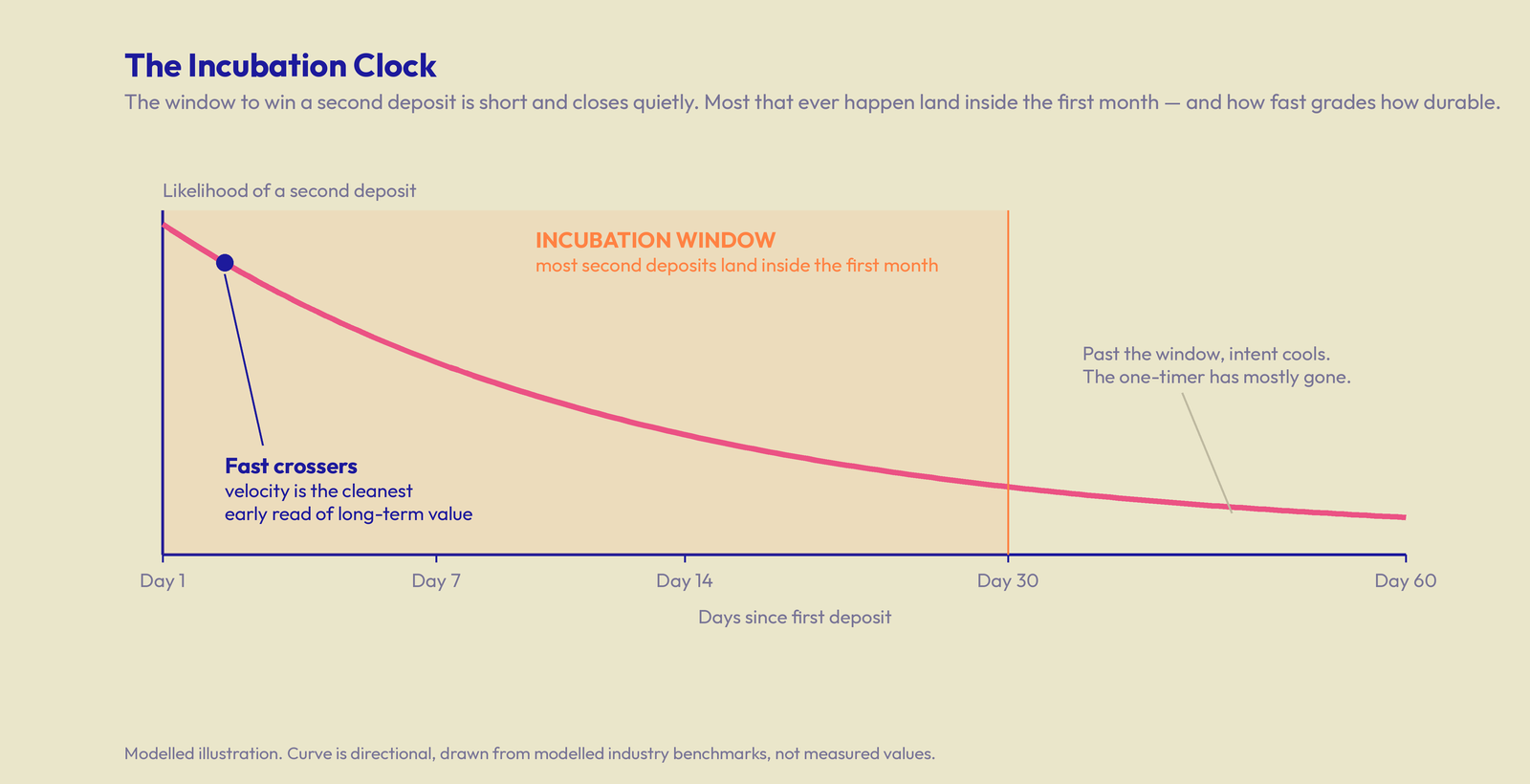
That instinct misreads the clock. The window to convert a first-time depositor into a second is narrow and it closes quietly. Most second deposits that ever happen land inside the first month. Past that boundary, intent cools, and the same offer that would have tipped the player in week two buys far less in week six. The one-timer who hasn't crossed in a month hasn't paused. They've mostly gone.
We call that window the Incubation Clock — the short, hard period in which the second deposit either happens or stops being likely. And the clock does double duty: it's not only a deadline, it's a thermometer. How fast a player crosses grades how durable they'll be. The player who redeposits inside 48 hours is a different prospect from the one who takes three weeks, even though both ended up on the right side of the line. Velocity is signal. The quick second deposit is one of the cleanest early reads of long-term value you have.
Which raises the obvious problem: the clock is running during exactly the period when you know least about the player. You're being asked to prioritise, time, and tailor the push toward a second deposit before any history exists to tell you who's worth pushing. That's the gap D1LTV — Day-1 Lifetime Value Prediction, one of HumanGraph's three core engines, is built to close: it scores a player's likely value from the first deposit and first sessions, so the incubation window can be spent acting on a reading instead of waiting for the cliff to resolve the guess for you. The second deposit will tell you who this player was. D1LTV is the attempt to know it a month sooner.
A one-timer isn't a player you can reach later. They're a player on a clock you can't see.
4. The weekly rhythm you're not using
For the players who don't cross in the first few days, the default re-engagement move is a generic blast — the same reminder, the same offer, fired on whatever day the campaign calendar happens to land on.
That ignores the most usable pattern in the whole second-deposit funnel. Players who don't redeposit within their first week tend to come back on the same day of the week as their first deposit. A casino player whose first deposit was a Friday night skews heavily toward a Friday second deposit; a sports bettor who funded for the weekend fixtures re-triggers on the weekend. It tracks weekly leisure routines, and it's predictable enough to build on: segment your one-timers into seven cohorts by first-deposit weekday, and fire each cohort's nudge on their day — ahead of it, when intent is rising, not at random. For sportsbooks, that means aligning the prompt to the fixture calendar the player is already living by.
The player has already told you when they're most likely to come back. Generic scheduling is a decision to ignore them.
5. The second deposit dies at the cashier more often than at the offer
When second deposits stall, the reflex is to reach for a bigger reload — to assume the player needs more incentive to come back.
Often the offer was never the blocker. The friction was. A returning player who has to re-enter full card details, clear an awkward verification step, or fight a clumsy deposit flow will abandon a transaction they'd already decided to make — and tokenised, one-click returning deposits remove a barrier that has nothing to do with how generous you're being. Stranger still, the strongest lever on the second deposit is often the withdrawal. A player who requests a payout early and gets it fast and cleanly has just learned the platform is trustworthy — and that lesson drives redeposit harder than almost any bonus. The inverse is brutal: slow payouts are among the most common reasons players abandon a platform outright. Treating a new player's first withdrawal as a high-priority event — automated, fast, frictionless — is one of the most underrated second-deposit tactics there is.
Whether a reload offer is even the right tool, and what it costs you when it isn't, is the territory of The Generosity Trap. The narrower point here: before you raise the offer, check whether the player was trying to come back and the cashier wouldn't let them.
A player blocked at the cashier didn't reject you. They just couldn't reach you.
6. Spend the incubation window like it's the whole game
Most retention attention, and most retention budget, is aimed at players who already have a track record — the lapsing regular, the cooling VIP, the win-back list. All of it operates on the far side of the Repeat Cliff, on players whose odds already inverted in your favour weeks ago.
The leverage was earlier. By the time a player has the history that makes them easy to manage, the hardest and most decisive transition of their lifecycle is already behind them — won or lost inside a window most operations never treated as a window at all. The incubation period gets none of the deliberate design that the win-back campaign gets, despite deciding far more.
Reframing it changes the work. The one-timer stops being a low-priority reactivation target and becomes a player on a closing clock. The second deposit becomes the metric the first month is built around, with a knowable weekly timing window attached. The first withdrawal becomes a retention event. And the push toward the Second-Deposit Line gets pointed, from Day 1, at the players most likely to repay it — because you read them early, rather than waiting for the cliff to read them for you.
The player who deposits twice is a different business than the one who deposits once. The whole question is how much of your operation is built to get them there before the clock runs out.
We built HumanGraph to operate against exactly this problem. If getting more players across the Repeat Cliff — and reading who's worth the push before the history arrives — is something you'd like to act on at your operation, we'd like to compare notes.