The first 14 days aren't an onboarding flow. They're a retention programme.
Most operators run the first two weeks as an onboarding flow that ends at the first deposit. That's the mistake. The first deposit is the Starting Gun — the opening of the highest-leverage retention window in the lifecycle.

TL;DR — Most operators run the first two weeks as an onboarding flow that ends the moment the first deposit clears — a conversion job handed off to retention later. That framing is the mistake. We call the first deposit The Starting Gun: not the finish line of acquisition, but the opening of the highest-leverage retention window in the entire player lifecycle. Build the first 14 days to form a habit, and you stop refilling a bucket that leaks fastest in the first fortnight.
In the previous articles in this series — The Invisible Window, The Descending Curve, The Competitor Exposure Window, The Value Visibility Gap, and The Generosity Trap — we argued that long-term retention is largely decided in the first 14 days. The player who builds a habitual reason to return inside that window becomes durable. The one who doesn't quietly disappears. That claim was the foundation. This is the article that opens the window and looks inside it.
Because the way most gaming companies treat the first two weeks gives the game away.
1. The first deposit is the wrong finish line
Onboarding is run as a flow: a sequence of screens and welcome offers that ends the moment the first deposit clears. The first deposit is framed as the finish line — the point where acquisition hands off and retention picks up, later.
That framing is the mistake. The first deposit is not the end of acquisition. It is the start of retention, and the first 14 days are where retention is won or lost. Treated as a flow, the window is a checklist that ends too early. Treated as what it actually is, it becomes the single highest-leverage period in the entire player lifecycle.
We call the first deposit The Starting Gun — the moment a player stops being someone you acquired and becomes someone you are trying to keep. A starting gun doesn't end a race. It begins one. Every operator who treats it as a finish line is declaring victory at the exact moment the work that matters most is supposed to start.
The first deposit isn't where you won the player. It's where you started trying to.
2. The 14 days decide the years
The clearest finding in player behaviour is that early retention doesn't just correlate with long-term value — it predicts it with unusual force.
Day-7 retention is the most sensitive leading indicator in the lifecycle. It moves more than any other metric in response to onboarding changes, and it tracks tightly with Day-30, Day-90, and Day-365 active rates. A player engaging and depositing inside the first week is far more likely to become a multi-year, high-value relationship. The reverse is just as reliable: operators who fail to optimise the Day 0 to Day 7 phase tend to run Day-30 retention materially below peers with mature activation sequences — in modelled benchmarks, a gap on the order of a third to a half.
(Figures throughout this article are expressed as ranges drawn from modelled industry benchmarks; treat them as directional, not precise.)
The stakes of that gap are higher in iGaming than almost anywhere else, because of how revenue concentrates. A small minority of players fund the bulk of platform earnings. So a contraction in early retention doesn't shave a thin layer off a broad base of low-value users — it disproportionately strips out the high-potential players who were on their way to funding the entire marketing budget. The players you lose in the first fortnight are not evenly distributed. You lose your future best players at the same rate as everyone else, and they are worth far more.
The benchmarks make the available difference plain. Average iGaming Day-7 retention sits somewhere around a fifth to a third of new players, falling further by Day 30. Best-in-class operators — those running real-time engagement and well-sequenced gamification — hold materially higher at both marks. The documented lifetime-value uplift between a baseline onboarding and a fully optimised one runs from roughly a third to several multiples.
That is not a tuning difference. It is the difference between a business that compounds a retained cohort and one that stays on the acquisition treadmill, paying somewhere between €200 and €600 per first-time depositor to refill a bucket that leaks fastest in the first two weeks.
3. The second deposit is the real finish line
If the first deposit is the wrong place to declare victory, the second deposit is the right one. It is the moment a player stops being an acquisition event and starts becoming a habit. We call it The Second-Deposit Line — the first threshold that actually separates a retained player from a one-and-done.
The numbers around it are sobering. Roughly four in ten players never make a second deposit. Healthy first-to-second-deposit conversion sits near three in five, with the best operators pushing higher — which means even good performance leaves a large share of new depositors as one-and-done. That single transition is the most concentrated point of value leakage in the entire lifecycle, and it happens early enough that it is also the most changeable.
The timing of the second deposit is more predictable than most teams assume. For players who don't re-deposit within the first week, the eventual second deposit tends to cluster on the same day of the week as the first — a casino player who deposited on a Friday night is disproportionately likely to make their second deposit on a Friday. This isn't coincidence. It tracks weekly leisure routines. And it hands CRM teams a precise, repeatable intervention window most of them aren't using. The player has told you when they are most likely to come back. The question is whether the system is built to notice and act on that rhythm — or whether it is waiting for a 30-day inactivity rule to fire long after the pattern has gone cold.
Registration-to-first-deposit conversion frames the top of this funnel, and where it's weak the cause is rarely the game catalogue. It is friction in the path between intent and money. Which is where most onboarding actually breaks.
4. Most onboarding failure is process failure, not product failure
The instinct when early retention disappoints is to look at the product — the game library, the welcome offer. That instinct is usually wrong. Onboarding fails most often in the transactional and operational plumbing, not the entertainment.
Payment friction is the most acute and most measurable driver of early churn: a meaningful share of players abandon a platform over deposit and withdrawal complications, with slow deposit processing and slow withdrawals cited most often. The pain is specific. A player who can't get money in quickly on Day 0, or can't get a win out smoothly in the first week, has learned everything they need to know about the relationship before the product ever had a chance to perform.
The second process failure is quieter and almost entirely self-inflicted: delayed reward delivery. Many operators still process campaign and reward logic on hourly or nightly batch cycles. A player completes their first deposit or clears a mission, then waits — sometimes the better part of a day — for the bonus or free spins that were supposed to reward the action. By the time the reward lands, the session is over and the emotional context that gave it meaning has evaporated. The reinforcement loop that turns an action into a habit only closes if the reward arrives while the player is still in the seat. Break that loop and you degrade early retention through a database scheduling decision, not a product one.
The fix is not a better catalogue. It is real-time event processing that issues the reward inside the active session, while excitement and context are still high. This is the same architecture that makes early disengagement visible — the thinking behind COD — Churn Onset Detection, one of HumanGraph's three core engines. The signal that a player is drifting and the signal that a player just earned a reward both have to be read and acted on in the moment. Batch cycles were built for reporting. The first 14 days demand something that operates while the player is still there.
A reward that is confusing or slow does not reinforce a habit, however generous it looks on paper — and the economics of that are the subject of The Generosity Trap. For onboarding, the point is narrower: speed and clarity reinforce; delay and opacity don't.
5. The right mechanic at the right moment
Gamification is where the first two weeks are most often run on instinct rather than sequence. The common error is not using too little or too much — it is deploying the wrong mechanic at the wrong stage.
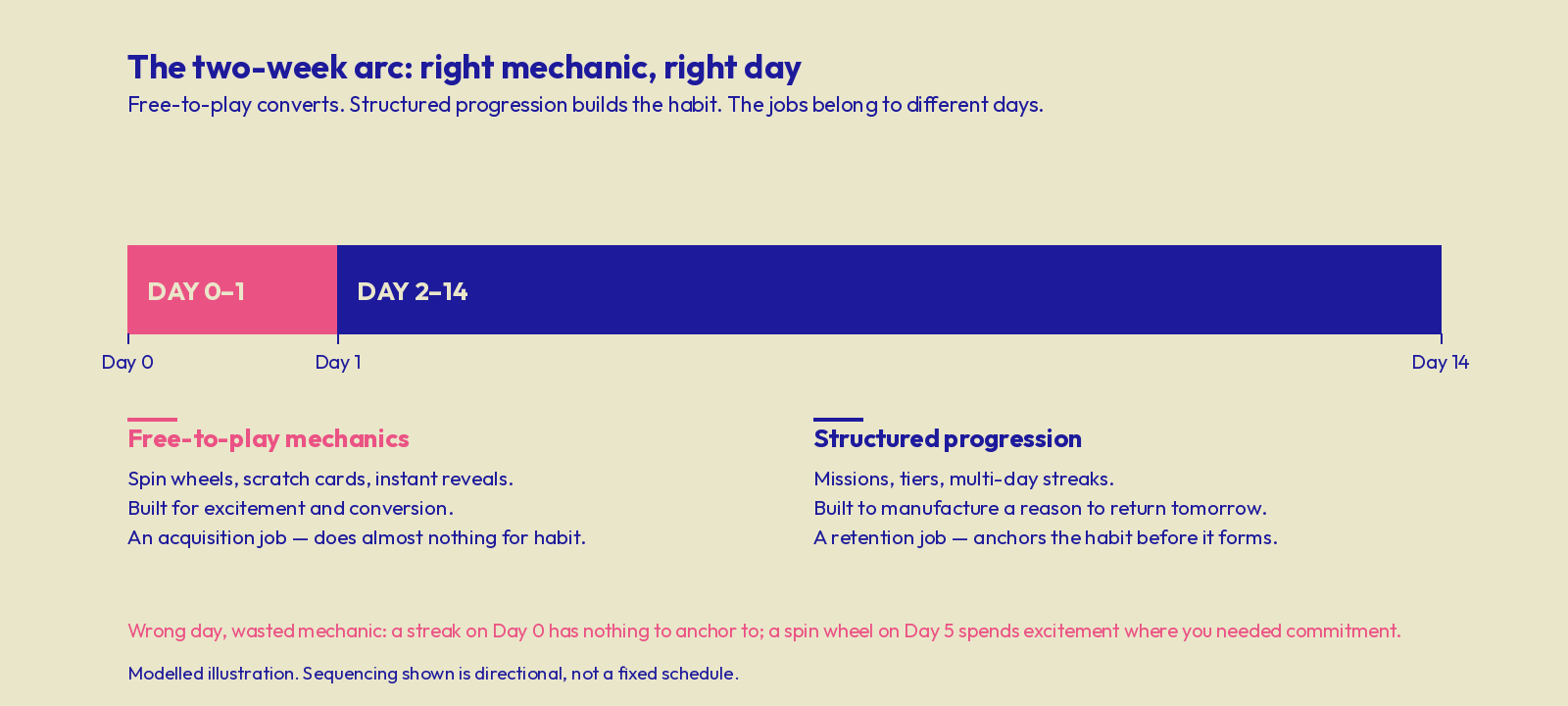
There are two distinct jobs, and they belong to different days. Free-to-play mechanics — spin wheels, scratch cards, instant-reveal rewards — are built for excitement and conversion. They earn their place on Day 0 and Day 1, turning registration friction into a small win and nudging the first deposit. They are acquisition mechanics. They do almost nothing for habit.
Structured progression — missions, tiers, streaks — does the opposite job. It is built to manufacture a reason to return tomorrow, and its window is Days 2 through 14. Deploy a streak on Day 0 and it has nothing to anchor to. Deploy a spin wheel on Day 5 and you have spent excitement where you needed commitment. A visible multi-day streak works because of loss aversion: once a player can see the progress they've built, the prospect of breaking it pulls them back daily in a way no re-engagement email reliably matches. In modelled cohorts, sequencing progression mechanics into the first ten days produces double-digit lifts in next-day logins, second-deposit conversion, and deposit frequency and value.
The mechanic doesn't create value by being generous. It creates value by giving the player a structured, self-chosen reason to come back before the habit would have formed on its own. And the players worth sequencing this most carefully are the ones whose early behaviour already marks them as future high value — re-depositing quickly, escalating stakes, logging in repeatedly. Those patterns are visible inside the first week, and reading them is the job of EVIP — Early VIP Identification, another of HumanGraph's core engines. When the patterns appear, the player should be routed out of the generic journey before a flat welcome sequence trains them to expect ordinary.
Sequence matters as much as selection.
6. Onboarding is the retention programme most teams are missing
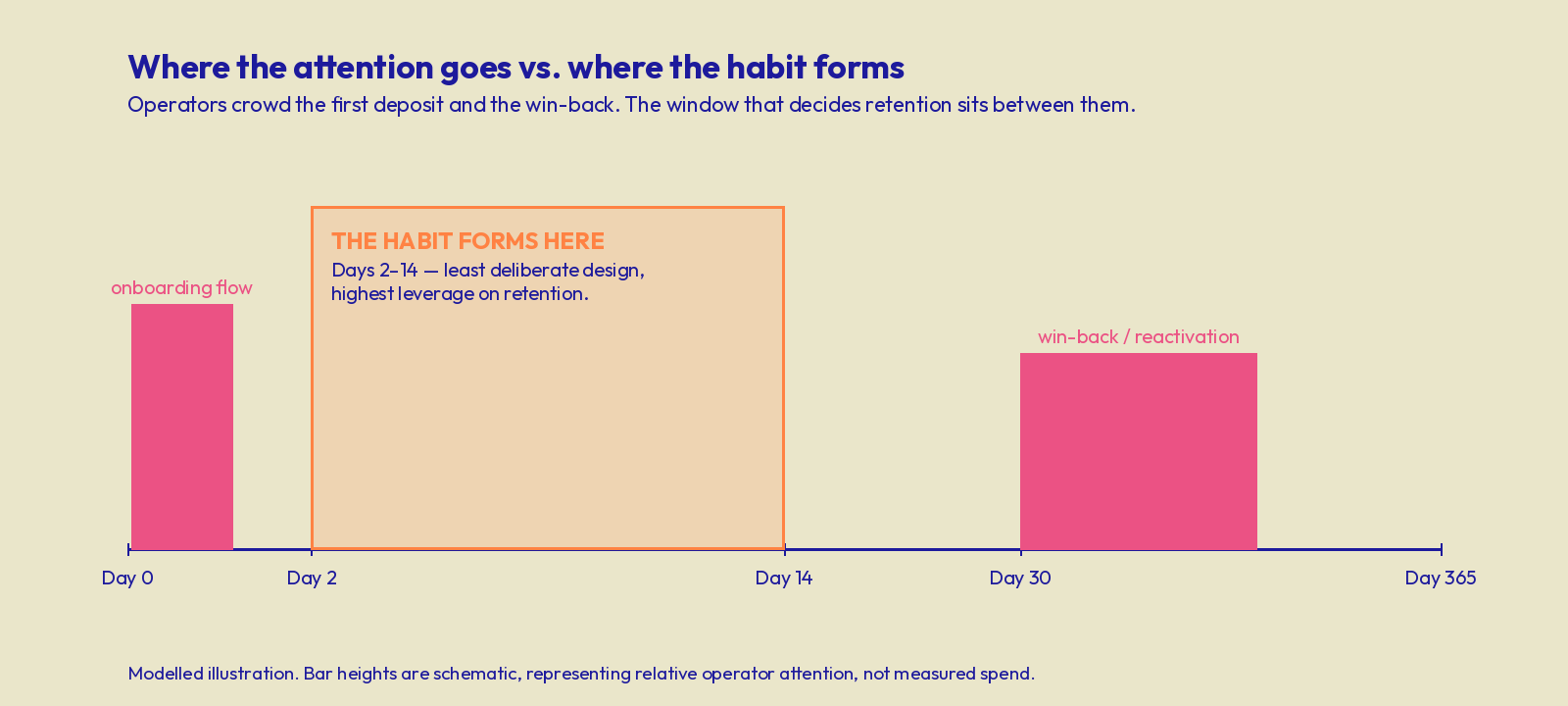
Retention budgets in iGaming are large, and most of the attention they buy is pointed at players who already have an established pattern — the win-back campaign, the lapsing-VIP alert, the reactivation offer. All of it fires after the habit either formed or didn't.
The first 14 days are where that outcome is actually decided, and they are the period that receives the least deliberate retention design. They are run as an onboarding flow — a conversion job that ends at the first deposit — when they are in fact the most important retention programme the business operates.
Reframing the window changes what gets measured and when teams act. The first deposit stops being a finish line and becomes The Starting Gun. The second deposit becomes the metric that matters, with a knowable weekly timing window attached. Reward delivery becomes a real-time obligation, not a batch job. Gamification becomes a sequenced two-week arc, not a scattering of mechanics. And the single journey gives way to a small set of journeys matched to who the player is turning out to be.
None of this requires more spend. It requires treating the first fortnight as what it is. The operators who pull ahead on retention aren't the ones with the biggest welcome offer. They're the ones who understood, early, that the habit forms in the first two weeks — and built the first two weeks to form it.
We built HumanGraph to operate against exactly this problem. If turning the first 14 days into a real retention programme is something you'd like to act on at your operation, we'd like to compare notes.