Your Next VIP Is Already Playing. You Just Don’t Know It Yet.
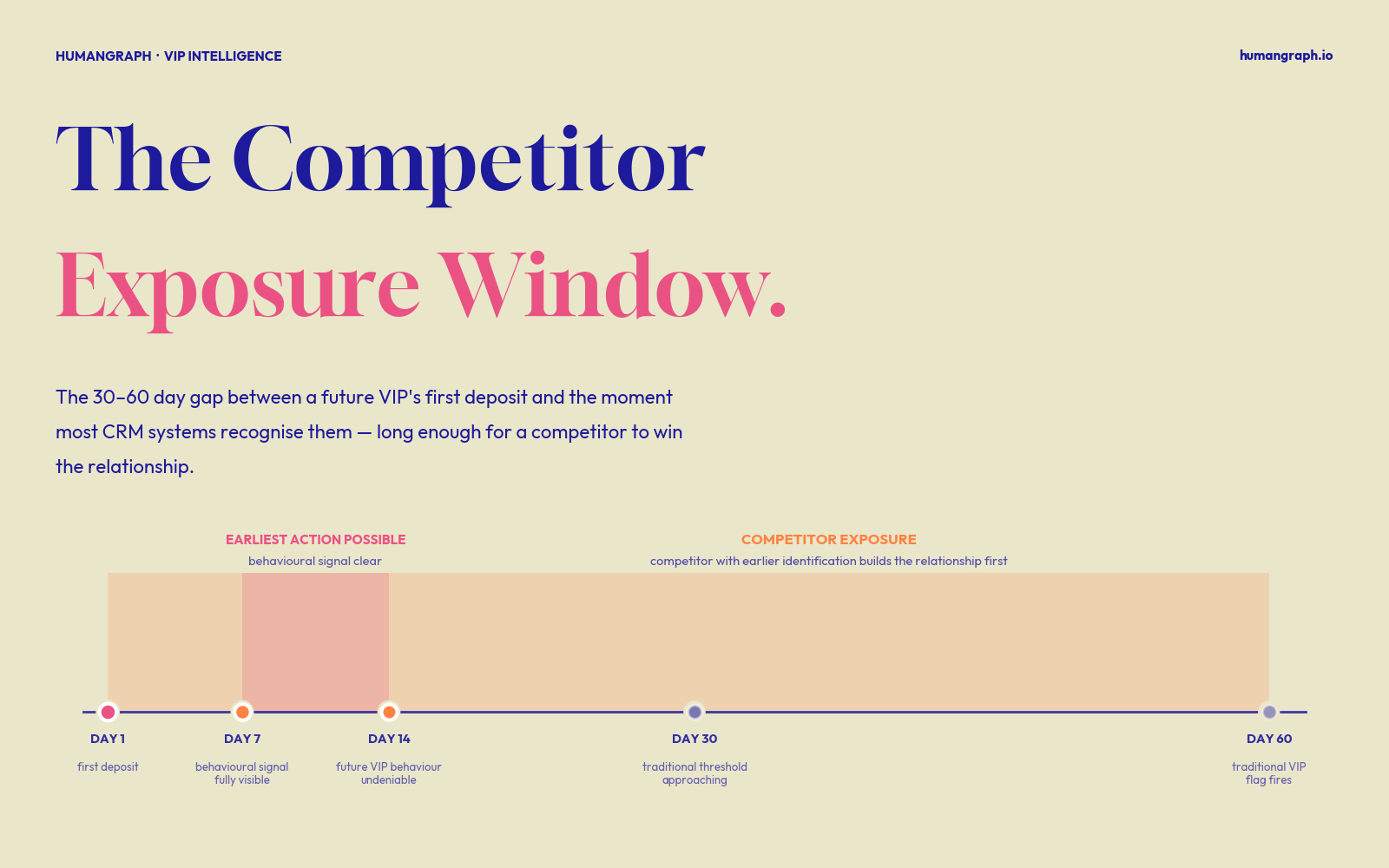
Most operators identify their highest-value players 30–60 days too late. By then, the relationship has already been shaped — and a competitor with earlier intelligence has had open access. This is the Competitor Exposure Window.

TL;DR — The economics of iGaming concentrate revenue in a small minority of players. Most operators identify these players only after they cross a financial threshold — typically 30–60 days in — by which point generic onboarding has shaped the relationship and competitors have had open access. This article explains the Competitor Exposure Window, why future high-value players are behaviourally distinguishable within their first two weeks, and what changes commercially when identification happens earlier.
1. The timeline operators aren’t working inside
In the first two articles in this series (The Invisible Window and The Descending Curve), we argued that the cost of acting late on player behaviour is structurally underestimated. The opportunity to influence
retention is narrower than most CRM systems are built for, and the economics of late intervention are worse than they appear.
The same logic applies at the opposite end of the player journey.
The timeframe to identify a future high-value player and begin the relationship that will make them stay is also narrower than most operators are working inside. And the cost of missing it is, if anything, larger.
The economics of iGaming are built on a deeply asymmetric foundation. A small minority of players generate the majority of total revenue. Industry data consistently shows that the top 1% of players by spend account for around 35–40% of net revenue. The top 20% account for close to 90%. In virtual casino products, the concentration is even steeper — the top 1% alone can account for close to 60% of total wins.
That concentration is the defining commercial reality of the business. And the central challenge it creates is not how to service these players once they have been identified. It is how to identify them before the relationship has already been shaped by generic, low-touch treatment.
This is not a CRM segmentation problem. It is a timing problem.
2. Why the first two weeks decide more than they should
Industry-wide, Day 1 retention across the player base is often below 30%. By Day 7, it drops sharply. For the general player population, these numbers reflect the familiar challenge of converting newly acquired players into habitual users.
But future high-value players do not behave like the average.
They return quickly. They engage with intensity. They make their second deposit within 24 hours of their first at a rate roughly double that of the general player population. Within their first week, the patterns that distinguish them from casual players are already visible.
The problem is that most VIP qualification systems are not looking at this early stage. They are waiting.
A player needs to deposit a certain amount in a month. Or wager a certain cumulative volume. Or maintain a certain activity level over a 60-day period. These thresholds are designed to confirm value after the fact — not to identify potential before it is fully realised.
By the time a player crosses a traditional threshold, they have typically been on the platform for weeks or months. They have already formed their habits. They have already decided which brand feels like home. They have already had time to be discovered by a competitor.
The first two weeks are not a qualification period. They are a relationship-forming period. And most operators are treating them as the former while losing them as the latter.
3. What future high-value players look like early
The behavioural patterns of future VIP players are detectable well before they show up in financial metrics.
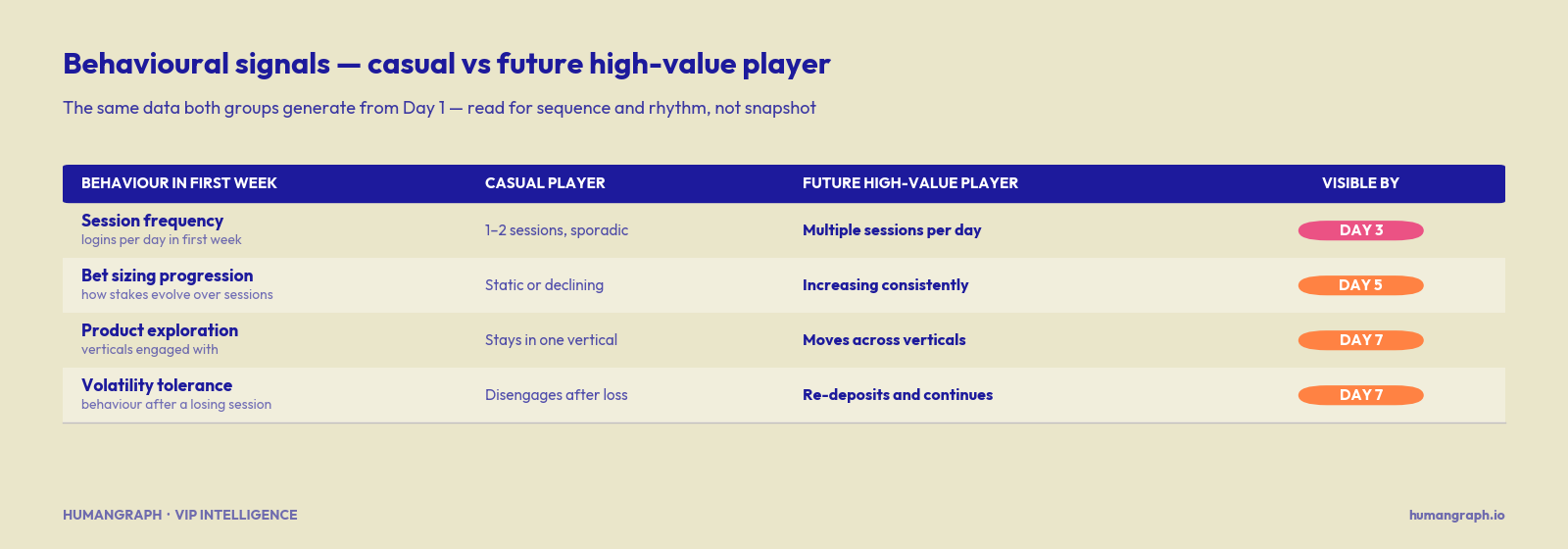
Several early indicators tend to distinguish them from the casual or promotional player.
Session frequency in the first week is higher — multiple sessions in a day rather than one every few days. Bet sizing tends to increase consistently across the first few sessions rather than remaining static. Product exploration is broader — future high-value players often move across verticals, combining sportsbook, live casino, and slots, rather than staying in one area.
Return cadence is particularly telling. Future high-value players tend to log in daily during their early period, even before their spend has reached significant levels. They are building a habit, not responding to an offer. Beyond transactional metrics, social behavioural indicators provide a critical early signal. Future VIPs often demonstrate higher social attachment, visible through active participation in live dealer chat rooms, early engagement with community leaderboards, or a high responsiveness to initial outreach from a VIP host.
Volatility tolerance is another marker. After a losing session, the casual player often disengages. The future high-value player tends to re-deposit and continue. This resilience in the face of early losses is a behavioural pattern that correlates strongly with long-term high engagement.
None of these individually confirm future value. Together, they are visible long before the financial metrics catch up.
It is important to acknowledge what this same signal set means on the responsible gambling side. The behaviours that identify future high-value players — high frequency, increasing stakes, strong return cadence, high volatility tolerance — overlap meaningfully with the early indicators of harmful gambling behaviour. A system that surfaces VIP potential without simultaneously assessing harm risk is not a sustainable system, commercially or otherwise.
The implication is not to slow down identification. It is to run both tracks in parallel. The same early behavioural intelligence that flags VIP potential can flag early harm indicators: loss-chasing patterns, rapid consecutive deposits after losses, session lengths that suggest compulsion rather than leisure. A well-designed early identification system should surface both simultaneously, so the commercial response and the player-protection response are made together. That is what makes an early VIP programme defensible — and durable.
4. The Competitor Exposure Window
Late VIP qualification does not just delay the relationship. It actively creates risk.
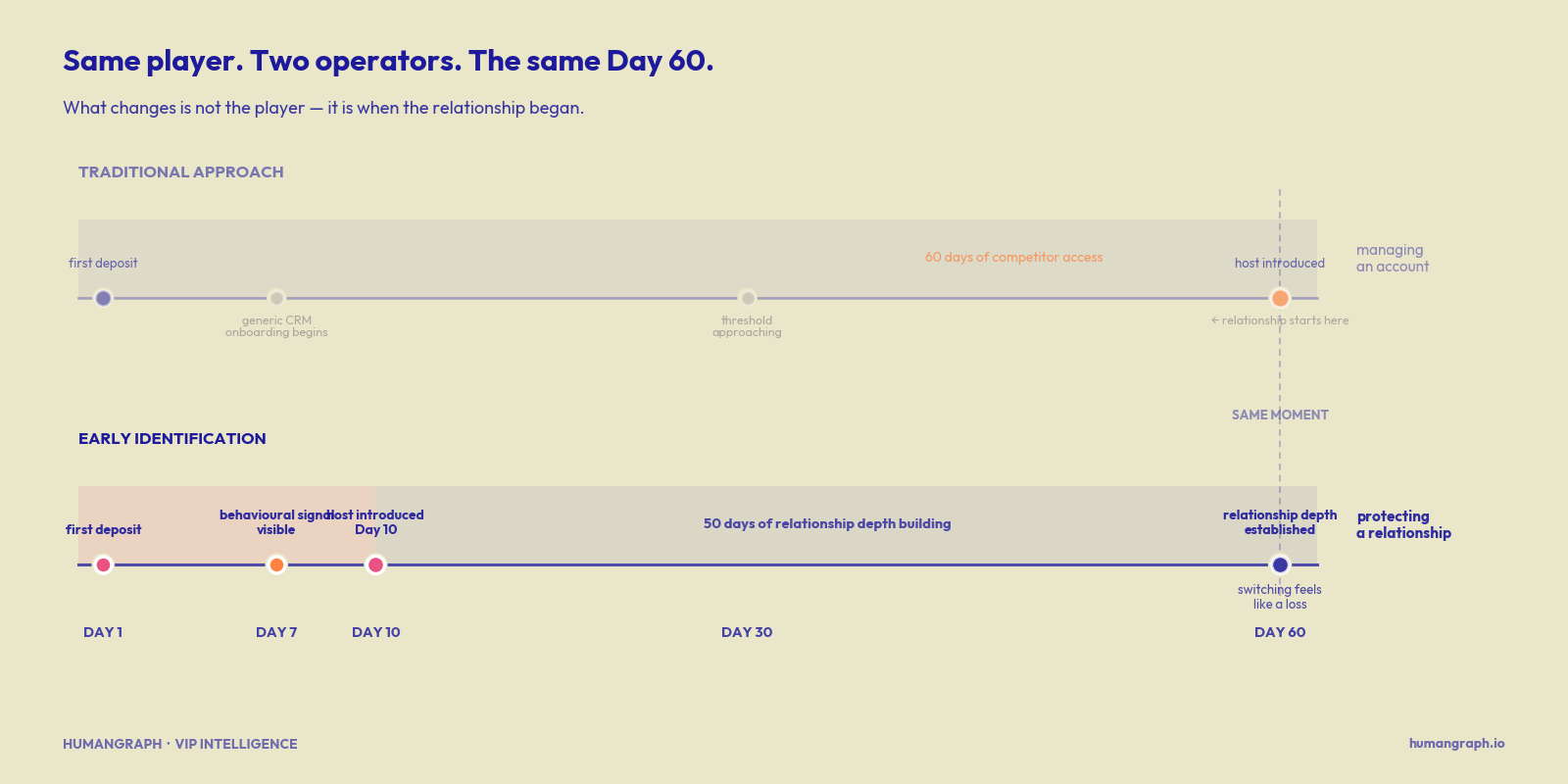
We call this the Competitor Exposure Window — the period after a high-potential player’s first deposit but before any operator has begun a genuine relationship with them. For most operators, that window is between 30 and 60 days long. For a player who will eventually represent a meaningful share of an operator’s revenue, that is a long time to be left in a competitive vacuum.
During this incubation period, a future high-value player is making fundamental decisions about where to concentrate their activity. They are exploring platforms, comparing experiences, and forming the attachments — or the indifference — that will define their long-term behaviour.
If an operator is waiting for a financial threshold to be crossed before treating this player as high value, they are leaving them in that vacuum by default. Generic CRM communications. Standard onboarding flows. No personal contact. No acknowledgement of the behaviour that already distinguishes them from the crowd.
Meanwhile, a competitor with earlier identification capability may already be treating this player as a priority. The first brand to offer recognition, personalised service, and genuine attention during this incubation period has a structural advantage that becomes very difficult to reverse later.
The cost of late identification is not just missed revenue during the delay. It is the permanent damage to relationship depth — the foundation of long-term VIP retention — that could have been built during the most formative period of the player’s lifecycle.
This is the thinking behind EVIP — Early VIP Identification — one of HumanGraph’s three core engines.
5. Status and access retain VIPs. Bonuses don’t.
Once a future VIP is identified early, the question becomes what to do with that intelligence.
The research is consistent on this point: financial rewards alone do not build the kind of loyalty that retains high-value players over time. Cashback percentages, bonus credits, and free spins are useful tools — but they are replicable. Every competitor can match a cashback rate. No competitor can replicate a relationship.
What builds switching resistance in high-value players is experience-led engagement: status recognition, personalised service, priority access, and the sense that the brand genuinely knows them as an individual. These are things that take time to develop — which is precisely why early identification matters so much. The earlier the relationship begins, the more depth it can accumulate.
A VIP host who enters a player’s journey at Day 3 — before spend has fully materialised, before habits are fixed, before any competitor has made a move — can learn preferences, establish rapport, and build the kind of familiarity that makes switching feel like a loss rather than an option.
A host who enters at Day 60, when the player has already crossed a financial threshold, is not building a relationship. They are managing an account. The difference in long-term retention outcomes between these two scenarios is significant.
Multiple small moments of recognition and personalisation create stronger emotional attachment than a single large financial reward of equivalent value. A host who reaches out after a player’s first big win, or remembers a preference mentioned in passing, or resolves a friction point before it becomes a complaint — these interactions compound into genuine loyalty. A monthly cashback payment does not.
Cashback is replicable. A relationship is not.
6. From reactive recognition to proactive relationships
The traditional VIP model was built for a different era. It was designed to reward players who had already proven their value — to acknowledge the past rather than invest in the future.
The commercial logic of that model made sense when player data was thin, predictive capability was limited, and regulators were less focused on the VIP relationship. None of those conditions still apply.
Today, the behavioural data that distinguishes a future high-value player from a casual one is visible within days of first deposit. The models to interpret that data exist and are improving. The regulatory framework demands that any high-value relationship is founded on genuine understanding of the player — their financial context, their behaviour, their wellbeing — not just their spend.
The operators who will build the strongest VIP programmes over the next five years are not those who offer the biggest rewards. They are those who identify the right players earliest, begin building genuine relationships before the competition does, and manage those relationships with both commercial intelligence and genuine care for the player.
The first two weeks are not a waiting period. They are the most important period in the entire relationship.
We built HumanGraph to operate against exactly this problem. If the Competitor Exposure Window is something you’d like to close at your operation, we’d like to compare notes.