You commit the acquisition spend before you know what the player is worth. That gap has a cost.
Every player you acquire starts as a blank slate. So most operators wait for history before they act. We call the cost of that waiting the Cold-Start Tax. Here's how to stop paying it.

TL;DR — Every new player arrives as a blank slate, so most operators wait for weeks of history before they act — by which point the acquisition spend is committed and the player's value is already decided. We call this the Cold-Start Tax: the compounding cost of treating Day 1 as a waiting period instead of a readable signal. Operators who can score value from the first deposit stop paying it.
In the previous articles in this series — The Invisible Window, The Descending Curve, The Competitor Exposure Window, The Value Visibility Gap, and The Generosity Trap — we kept circling the same idea from different angles. Operators act on lagging data. The signal arrives before the action does, and the gap between them is where money leaks out.
This article is about the signal problem underneath all of them. The moment before there is any history at all.
1. Every player is a cold start
When a new player deposits for the first time, you know almost nothing about them. No deposit pattern. No session rhythm. No sense of whether this is a one-time punt or the first move of someone who will still be here in six months.
So the player sits in your system as a blank. And the instinct — a reasonable one — is to wait. Let a few weeks of behaviour accumulate. Let the player tell you who they are before you decide how to treat them.
That instinct feels like patience. It is actually exposure.
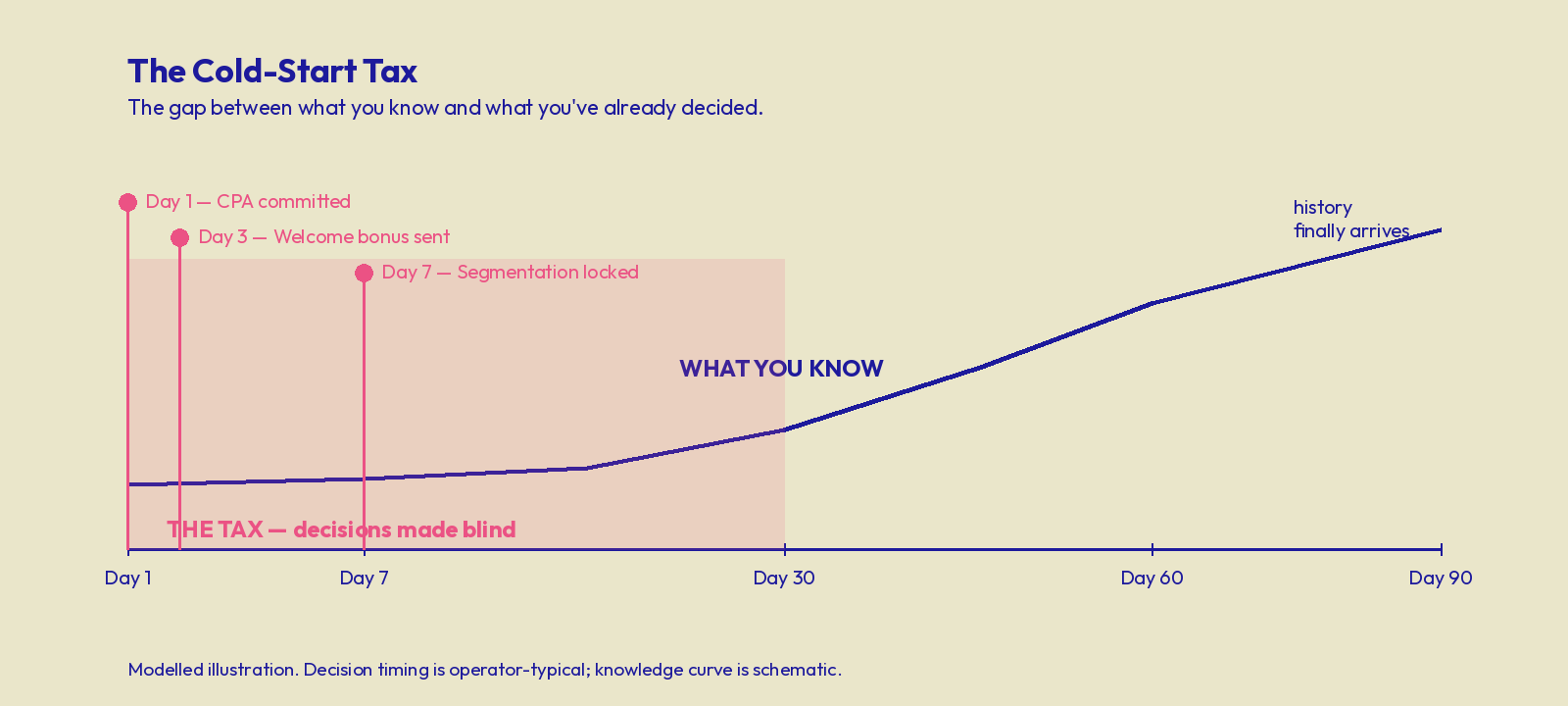
Because while you wait, decisions are still being made. The acquisition channel that brought this player in has already been paid. The welcome bonus has already gone out. The player has already been dropped into whatever default segment your CRM assigns to people it doesn't understand yet. None of those decisions waited for the history you're waiting for.
This is not an edge case that happens to a few unusual sign-ups. It happens to every player you acquire. The blank slate isn't rare. It's everyone, on Day 1.
2. What waiting actually costs
The reason the waiting feels free is that nothing visibly breaks when you do it. The player deposits, plays, and either stays or leaves. No alarm goes off to tell you that the way you treated them in week one was wrong.
But the cost is real, and it is structural. Look at what gets locked in before any history exists.
Acquisition spend is committed at the point of sign-up — you paid the same to acquire a player who will deposit once as you paid for one who will become a cornerstone of your revenue. The welcome offer is sent on the same logic to both. Early segmentation, the bucket that determines what communications and offers a player sees for their first weeks, is assigned before the player has done anything to earn a more accurate bucket.
By the time enough history accumulates to tell these players apart, the expensive decisions are behind you. You are now optimising the cheap decisions — a retention email here, a reactivation nudge there — on top of a foundation that was poured blind.
We call this the Cold-Start Tax — the compounding cost of treating Day 1 as a waiting period instead of a readable signal. It is compounding because every decision made during the blank period constrains the ones after it. A player mis-valued on Day 1 is mis-bonused in week one, mis-segmented in week two, and mis-prioritised by the time anyone looks closely.
Every day you wait for history is a day the decision gets made without you.
3. The signal is already there on Day 1
Here is the part that the waiting instinct gets wrong. Day 1 is not data-absent. It is data-sparse. Those are very different things.
Data-absent would mean you have nothing. That is never true. By the end of a player's first session you have observed how they deposited, how fast, in what size, at what time, with what intensity, and what they did between depositing and playing. You have the shape of a first session. You have the context around it.
It is not much compared to ninety days of history. But it is not nothing, and — this is the uncomfortable part — it is more predictive than most operators assume. The first deposit and the behaviour around it carry a surprising amount of signal about where a player is heading. The problem was never that the signal wasn't there. The problem is that nobody was reading it, because the prevailing assumption said there was nothing to read yet.
The operators who pull ahead here aren't the ones with more data. Early on, nobody has more data — everyone is working from the same sparse first session. The advantage goes to whoever extracts more from the same sparseness.
Sparse isn't empty. Most operators treat it like it is.
4. Two players, one Saturday night
Consider two players who sign up within an hour of each other on a Saturday night. Both deposit for the first time. On the surface your system sees the same thing: a new registration, a funded wallet, first play.
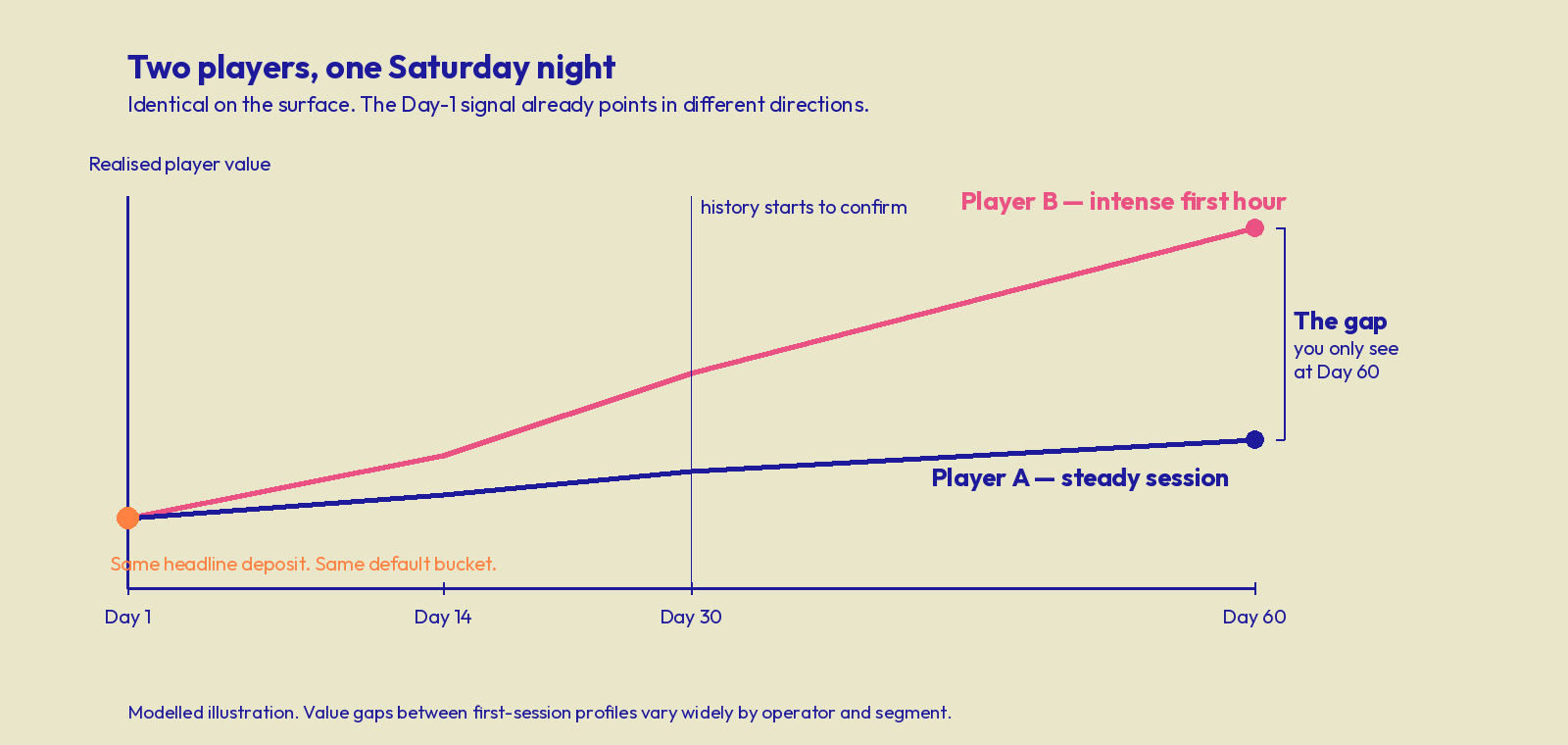
Player A deposits a modest amount, plays steadily through it across a relaxed session, and stops when the balance runs low. Player B deposits the same headline amount, but tops up twice within the first hour, with stake sizes climbing each time, compressed into a short and intense burst.
Same surface. Same headline deposit. To a system waiting for history, these two are identical — two new players in the same default bucket, receiving the same welcome treatment and the same acquisition cost attribution.
But the Day-1 signal is not identical. The shape of those two first sessions points in different directions, and a system reading the signal would treat them differently from the first hour — different value expectation, different offer logic, different early attention. In modelled benchmarks, the eventual value gap between first-session profiles like these tends to run wide, frequently in the range of several multiples by the time real history confirms it.
The operator waiting for history finds out around Day 60. By then both players have had the same money spent on them, the same bonus, the same generic first few weeks. One of them was worth that treatment. One was worth far more and never got it. One may have been worth far less and got more than the economics justified.
By the time history told them apart, the money was already gone.
5. What changes when you score from Day 1
The fix is not more data. It is reading the data you already have, at the moment you already have it.
This is the thinking behind D1LTV — Day-1 Lifetime Value Prediction — one of HumanGraph's three core engines. Instead of waiting for ninety days of history to reveal what a player is worth, D1LTV scores the eventual value of a player from the signal present in their first deposit and first sessions. The blank slate gets a value estimate while the expensive decisions are still in front of you, not behind you.
That single change moves the whole sequence. Acquisition can be evaluated against predicted value per channel rather than raw cost per registration. Welcome offers can be scaled to where a player is heading rather than spread evenly across people you can't yet tell apart. Early segmentation starts from a value-aware position instead of a default one. The decisions that used to be poured blind get poured with a reading.
It is the same logic that runs through the rest of the series. EVIP reads the early signal that a player is becoming a VIP before the financial thresholds confirm it. COD reads the early signal of disengagement before the absence shows up in the data. D1LTV reads the earliest signal of all — the one present before there is any history to wait for. Operate earlier on the signal, in every case.
You don't need more history. You need to read the history you already have.
6. Stop paying the tax
The Cold-Start Tax is not a law of nature. It is a default. Operators pay it because the waiting instinct looks like prudence and the cost never sends an invoice. Nobody chooses it on purpose, which is exactly why it persists.
But it is optional. The signal that would let you stop paying it is already sitting in the first deposit of every player you acquire. The only question is whether anything in your operation is reading it before the expensive decisions get made.
We built HumanGraph to operate against exactly this problem. If the Cold-Start Tax is something you'd like to stop paying at your operation, we'd like to compare notes.