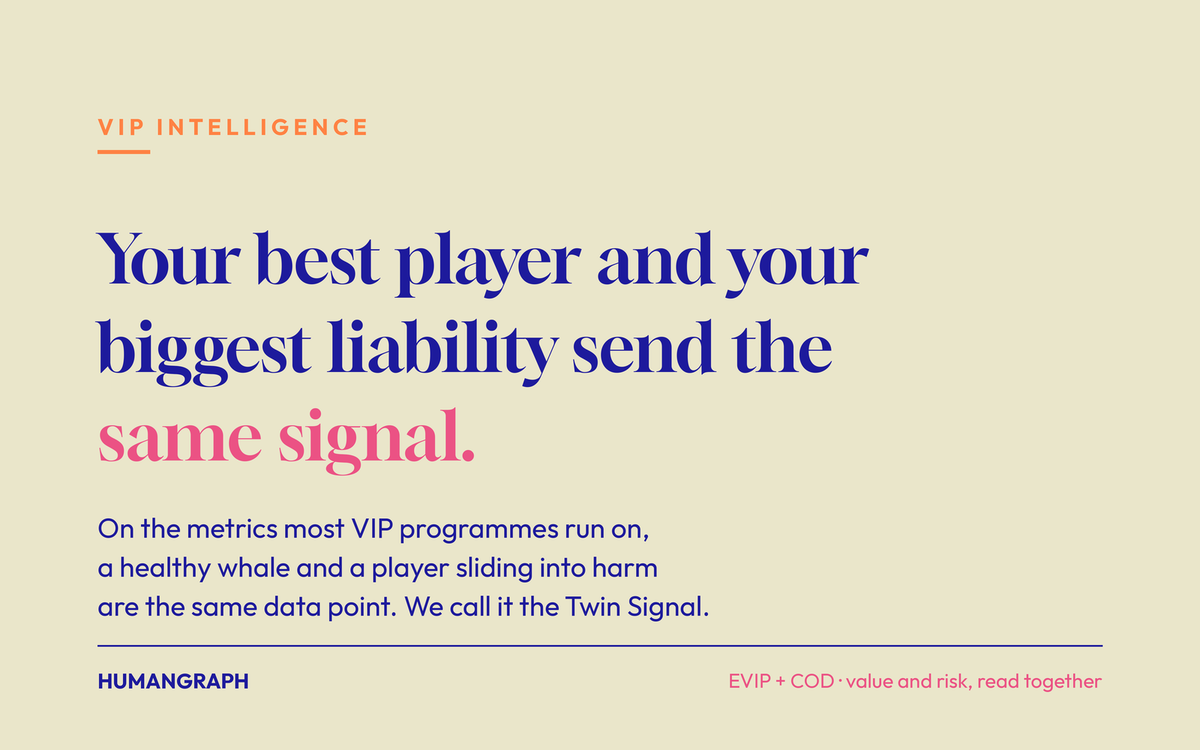
Your best player and your biggest liability send the same signal.
Healthy high-value play and gambling harm share almost every surface marker. On a single value score they're the same data point — the Twin Signal. The fix is the Dual Track: value and risk scored in parallel, with risk holding the veto.

TL;DR — Healthy high-value play and gambling harm share almost every surface marker: high frequency, large deposits, long sessions, a tolerance for losses. On a single value score, your best customer and your most at-risk one are the same data point — the Twin Signal. The fix isn't to slow down identification; it's to score every player on two parallel tracks at once, a Value Score and a Risk Score, where risk holds the veto. We call it the Dual Track. Across regulated markets it is moving from best practice to licence condition — and built frictionlessly, it protects the player, the margin, and the licence in the same motion.
In The Competitor Exposure Window, we argued that future VIPs are identifiable within days of their first deposit, and that waiting for a spend threshold hands them to a competitor who isn't waiting. That article ended on a tension it didn't resolve. The same early behaviour that marks a future VIP — high frequency, climbing stakes, a willingness to re-deposit after a loss — is also what the early stages of harm look like.
This is the article that turns that tension into a system.
1. Your most valuable player and your most vulnerable one look the same
Picture the account every commercial team wants more of. Deposits often. Deposits big. Long sessions. Doesn't flinch at a losing run. On a spend dashboard, that's a whale, and the instinct is to fast-track them into the VIP programme before a competitor does.
Now picture a player in serious trouble. Depositing often. Depositing big. Long sessions. Chasing losses instead of walking away. The behaviours that define your best customer and the behaviours that define your most at-risk one are, on a volume metric, the same behaviours.
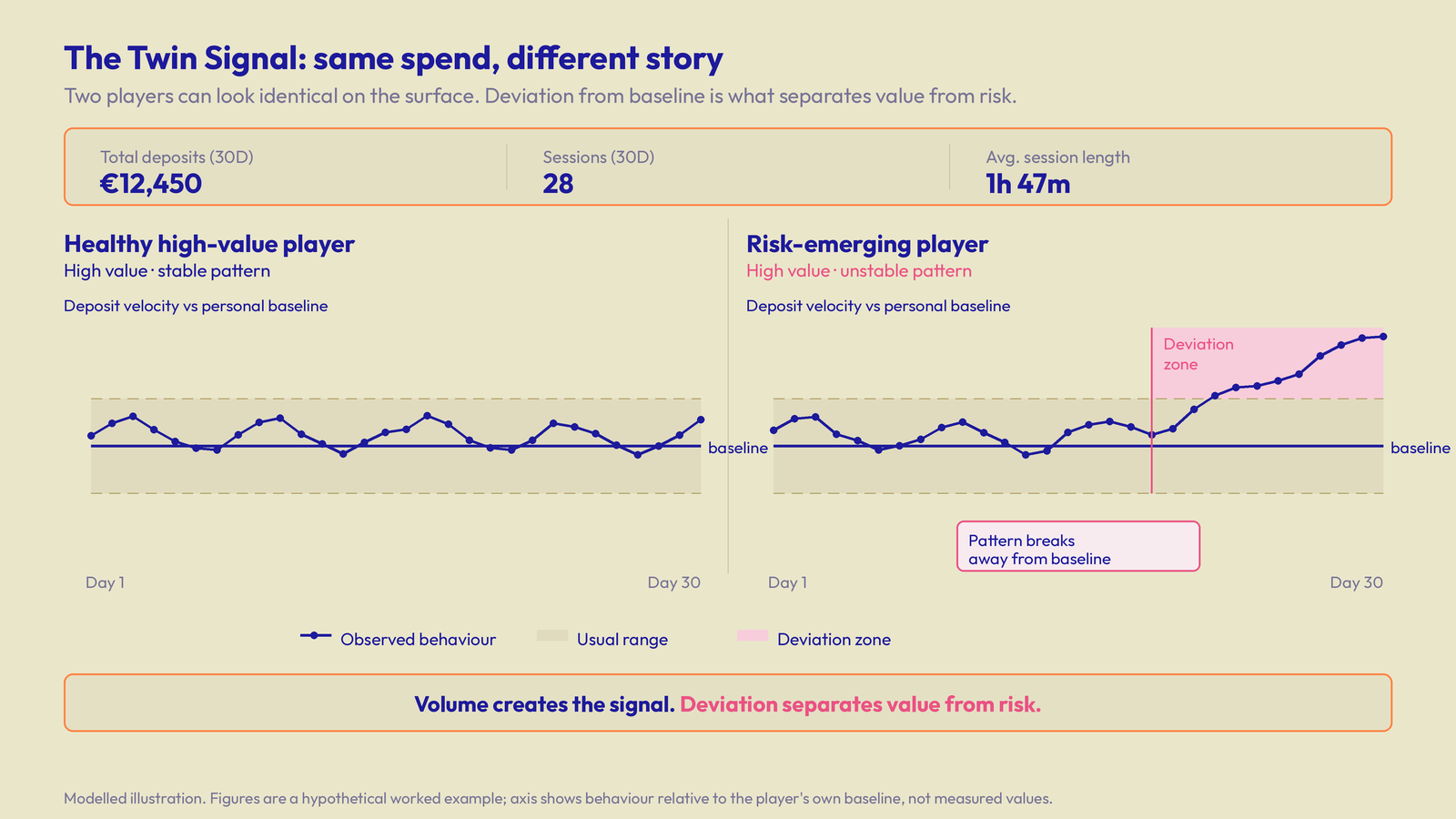
This is the Twin Signal: the single most expensive blind spot in VIP management. A segmentation model built on deposit volume, turnover, and session length will confidently flag both players as high value — and route both into escalated rewards, bigger bonuses, and a dedicated host. One of them is a multi-year relationship. The other is a regulatory case file forming in real time, and the programme just poured fuel on it.
On a spend chart, the whale and the warning sign are the same dot.
2. The difference isn't the volume. It's the shape
If you can't tell the two apart by how much a player wagers, the obvious question is what you can tell them apart by. The answer is the shape of the behaviour, not its size.
Healthy high-value play has a signature: steady. Deposits arrive on a recognisable rhythm, through consistent methods, in amounts that hold roughly stable month to month and sit within what the player can plausibly afford. The play is intense but planned — sessions start and stop, stakes stay in a band, the player has a baseline and lives inside it. A big bet from someone whose bets are reliably big is not a problem.
Harm has a different signature: deviation. The marker isn't a high number, it's an abrupt break from the player's own established pattern. Several rapid-fire deposits inside a single session. Deposit frequency spiking right after a loss. Average stakes climbing away from baseline with the pauses between decisions shrinking. A sudden jump from a preferred low-risk product into high-volatility slots immediately after a loss — the digital tell of chasing. Sessions drifting into the small hours, far outside the player's usual leisure window. And in the interface itself, the frustration shows: rage-clicks — rapid, repeated taps on an unresponsive button — run several times higher in gambling than in other digital sectors, and they cluster on withdrawal and deposit screens during exactly the sessions that have gone wrong.
None of these is visible on a monthly spend total. All of them are visible in real time, in the digital body language of the session, if something is built to read it.
A big bet isn't a problem. A bet that doesn't look like the player's other bets is.
3. One score can't carry both. So run two
The structural mistake underneath the Twin Signal is the single score. Most player-evaluation models collapse everything into one number — a value or HVC rating — and a single number physically cannot hold two opposite truths about the same player at once. It will always resolve the contradiction in favour of the louder signal, which is spend.
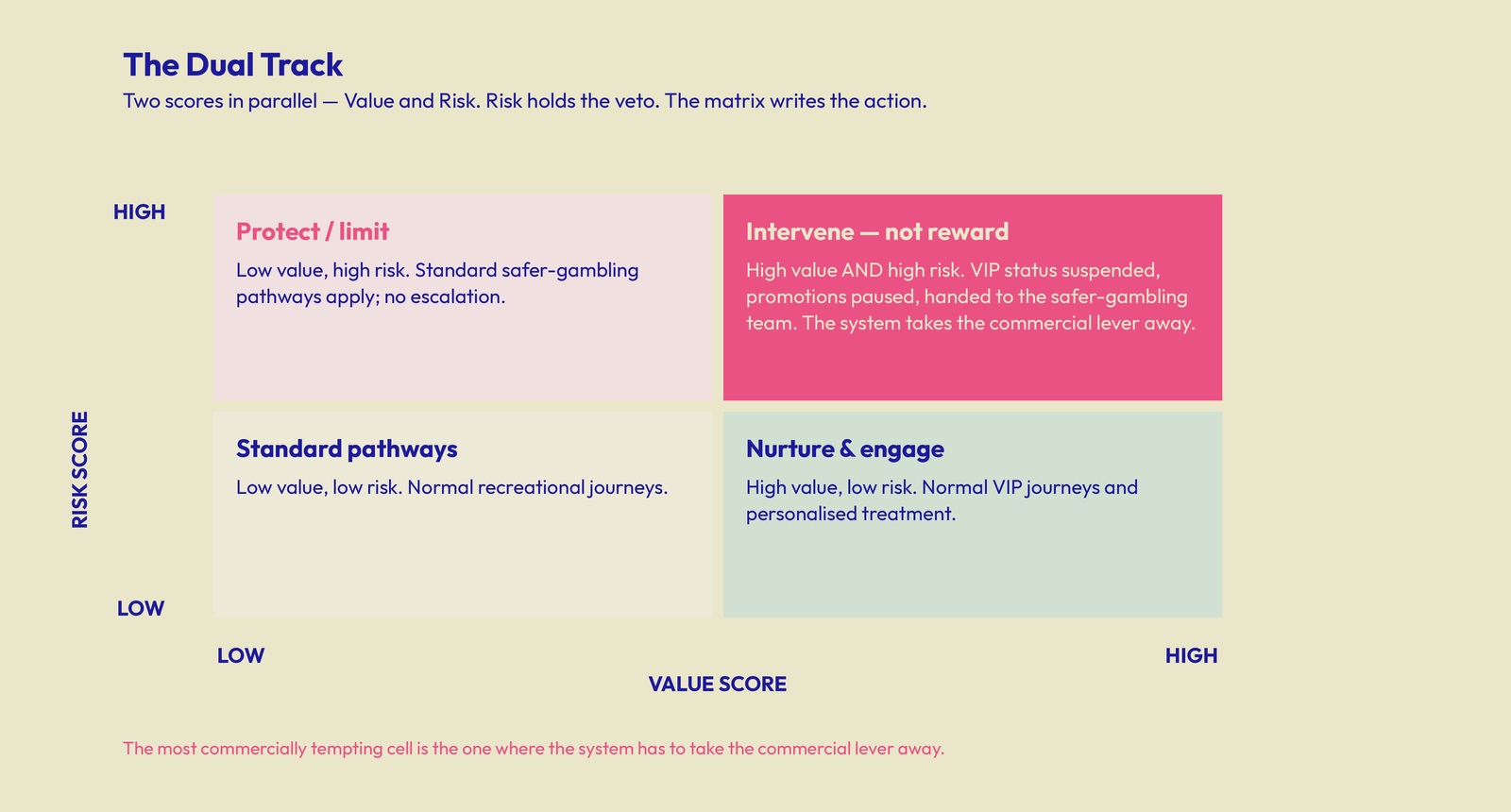
The fix is to stop asking one score to do two jobs. Every player carries two scores, calculated in parallel and updated continuously: a Value Score that models predicted lifetime worth from the depth, stickiness, and growth of their play, and a Risk Score fed by live compliance, AML, and responsible-gambling indicators — deposit velocity, withdrawal reversals, late-night shifts, the slots-to-sports ratio, financial-vulnerability markers, the friction tells. This is the Dual Track, and the rule that makes it work is simple: a high Value Score can never override a high Risk Score.
Read the two together and the matrix writes the action for you. High value, low risk: nurture and engage — normal VIP journeys, the personalised treatment the parent article argued for. Low value, low risk: standard recreational pathways. But high value and high risk is not a reward decision at all — it is an immediate intervention: VIP status suspended, promotions paused, the account handed to the safer-gambling team while a human reviews it. The most commercially tempting cell in the grid is the one where the system has to take the commercial lever away.
Reading both tracks from the earliest behaviour — value potential and harm markers in the same pass — is the job of EVIP — Early VIP Identification, one of HumanGraph's three core engines. A genuine early-identification system was always going to be dual-track, because the signal it reads is dual-natured at the source.
Risk holds the veto. No amount of value buys a player out of it.
4. The regulatory ground is moving toward this, not away from it
The reflex in commercial teams is to treat safer-gambling checks as a brake on revenue — a compliance tax to be minimised. That framing is going out of date, and the direction of travel is one-way.
Look at where the most demanding regulators have already landed, because it is where the rest of the market is heading. Tier-one jurisdictions now treat high-value customers as a heightened-risk category by default — not a reward tier to be protected, but a group to be scrutinised. Affordability and source-of-funds questions are moving ahead of reward eligibility rather than after it. The people managing VIP relationships are being structurally separated from the people running safer-gambling checks, and paying commercial staff on player losses is being designed out. Financial-risk assessment is shifting toward quiet, background checks that run on defined deposit thresholds rather than after a problem surfaces.
The model layer is moving too. Where AI is used to profile players, the emerging rule is that profiling to protect the business and detect harm is permitted and expected — while profiling to exploit a vulnerability, to engineer compulsive play through unpredictable reward timing, is being explicitly ruled out. Human oversight, logging, and governance over those models are becoming table stakes rather than differentiators.
And enforcement is the part that travels fastest across borders. Penalties for VIP failures now run well into eight figures in the strictest markets, arrive alongside mandated independent audits, and have cost senior licence-holders their jobs. The pattern in every published case is identical: a player throwing off obvious harm markers, a programme that kept rewarding them because the spend looked like value, and nothing built to read the difference. That pattern is jurisdiction-agnostic. Wherever a regulator tightens next, the dual track is what they will be testing for.
For an operator building now, the question isn't whether your current licence already demands this. It's whether you'd rather build it before the rule arrives or scramble after it does. The dual track stopped being an edge. It's becoming the floor.
5. Frictionless is the whole game
Here's the objection that kills most integration projects before they start: harm checks mean friction, friction means a worse experience for exactly the high-value players you're trying to keep, and a blocked withdrawal or a demand for bank statements is how you lose a VIP to a competitor. The objection is real. It's also a design problem, not a reason to skip the work.
The principle is frictionless-first. A silent background check runs on every flagged account — credit-reference markers, geo-affordability estimates, public-registry data — and branches on the result. A clean financial picture means zero customer-facing friction and continuous quiet monitoring; the player never knows a check happened. Distress indicators — active defaults, judgments, severe arrears — are what trigger a step-up to manual review. For the large majority of high-spending players, the check is invisible. Document requests are reserved for the small minority where the background data already shows trouble.
The same logic extends past verification into the live session. Behavioural biometrics — typing cadence, swipe and navigation patterns — verify identity continuously without a single extra step, and flag the session when a steady player suddenly turns erratic. And when an early harm marker fires, the CRM acts in the moment rather than the next morning: it suppresses the aggressive push notifications, cancels the queued VIP bonus, pulls the player off loss-chasing leaderboards, drops in a soft reality-check that shows time and money spent this session, and can steer toward lower-risk products or a break. Detecting that a player is drifting — disengaging, or sliding off their baseline — early enough to act on is the same real-time read that powers COD — Churn Onset Detection, another of the three engines. The signal that a player is in trouble and the signal that a player is about to leave are often the same signal, caught in the same window.
Get this wrong and the cost isn't only a poor experience. Most bettors say they would walk rather than hand over physical financial documents — and where they walk to is the unregulated black market, which checks nothing at all. Friction doesn't just annoy the healthy player. It exports them to someone worse.
Done right, the healthy player never feels the check. Done wrong, they leave — for an operator who isn't checking at all.
6. Protecting players is how you keep them
Strip away the regulatory pressure and the dual track would still pay for itself, because the commercial case and the protection case are the same case.
A player allowed to gamble with no boundaries is fragile in a specific way: they are one bad run from a catastrophic loss, and a catastrophic loss is almost always followed by immediate, permanent churn — the player gone, the distress real, the regulatory exposure live. The high-risk VIP isn't just dangerous. They're unstable, and the volatility that produces a huge month produces the burnout that ends the relationship weeks later. Most newly acquired players already churn inside a year; the unbounded high-roller churns hardest of all.
Smoothing that curve is what protection actually does. A player kept inside their genuine means plays for years instead of burning out in a fortnight, and the cumulative value of those years dwarfs the spike. The evidence is consistent and slightly counterintuitive: players who set their own limits retain better and are worth more, not less. Integrated systems that pair protective intervention with personalised engagement have cut manual review queues by more than half while blocking only a tiny fraction of players, and have lifted retention while measurably reducing the risk profile of the base at the same time. The largest listed operators now publish safer-gambling-adoption targets and keep growing players and cash flow as they hit them. Protection and profit stopped being a trade-off.
The old VIP model rewarded proven spend and asked the hard questions later — usually after a regulator asked them first. The dual track asks them at the same moment it reads the value, from the first sessions, so the commercial response and the protective response are a single decision rather than two departments arriving at different answers about the same person. A high-value player identified early shouldn't automatically get a bigger bonus. They should get the right response — which is sometimes a host and a personalised experience, and sometimes a proactive affordability conversation and a paused promotion. Knowing which, early, is the entire discipline.
We built HumanGraph to operate against exactly this problem. If turning VIP management into a genuine dual-track system — value and risk read together, early — is something you'd like to act on at your operation, we'd like to compare notes.